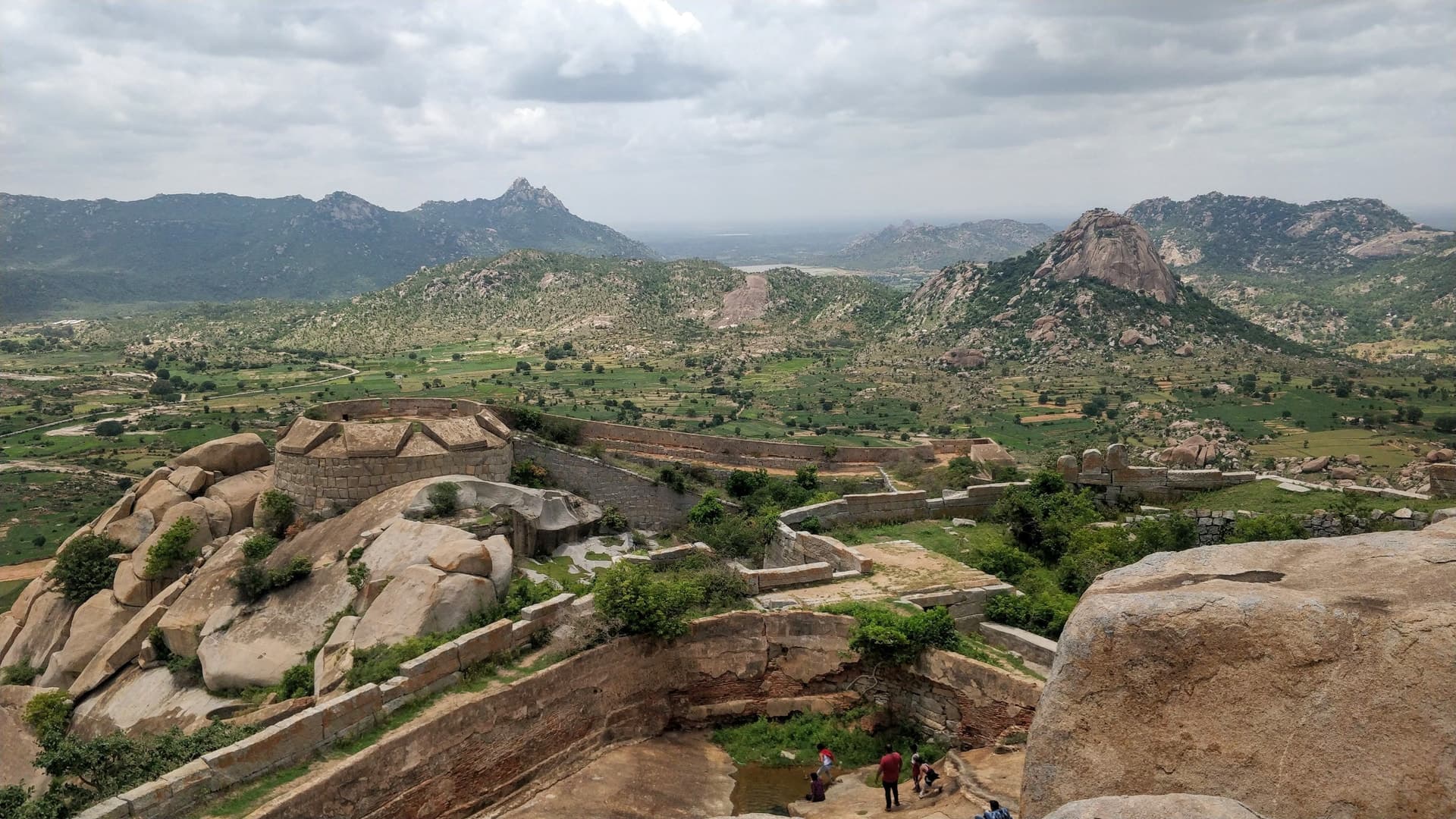
The Navadurga — Bangalore's Nine Hill Forts (+ Madhugiri, Devanahalli & More)
There's something about forts that I find deeply captivating — more than beaches, more than waterfalls, maybe even more than the open road. It's the weight of history in every stone. The bastions that once held off armies, the watchtowers where sentinels once stood through the night, the crumbling walls that outlived the kingdoms that built them. Forts don't just tell you history — they make you feel it.
Despite their dramatic settings and the stories they carry, forts are often the most underrated destinations in India. People drive past them for beaches and hill stations. But give me a granite hillock with a ruined fort on top over a crowded resort any day.
Bangalore — a city most people associate with traffic, tech parks, and craft beer — is quietly surrounded by some of Karnataka's most impressive fortifications. And the more I dug into this, the more I realised just how deep the rabbit hole goes.
Meet the Navadurga — the nine hill forts around Bangalore. I stumbled upon this concept while researching forts for a weekend trip, and I was genuinely stunned. Ten years of exploring around Bangalore, and I had no idea this existed as a collective. The Navadurga were built or reinforced largely by Kempe Gowda I, the 16th century chieftain who founded modern Bangalore, as a ring of defensive fortifications around the city. Together, they weren't just individual forts — they were a strategic system, a network of hilltop sentinels watching over the land from every direction. Nandi to the north, Savanadurga to the west, Makalidurga along the railway corridor, Hutridurga and Bairavadurga guarding the flanks — Bangalore was, in a very real sense, a fortified city.
That context changed everything for me. Every time I've driven to Nandi Hills or looked up at a rocky betta on a highway drive, I was unknowingly looking at a piece of this system. I've personally visited five of the nine so far. The rest are firmly on my list — and this article will keep getting updated as I tick them off.
The Navadurga — Nine Hill Forts Around Bangalore
The nine Navadurga, with approximate distances from Bangalore:
- Nandidurga (Nandi Hills) — 61 km via NH44
- Makalidurga — 58 km via SH9
- Savanadurga — 60 km via NH275
- Devarayanadurga — 71 km via NH48
- Hutridurga — 79 km via NH75
- Bairavadurga — ~60 km via Magadi Road
- Huliyurdurga (Kumbhi Betta) — ~80 km
- Channarayanadurga — ~100 km (near Madhugiri)
- Kabbaladurga — ~60 km (Bangalore Rural district)
Nandi Hills (Nandidurga)
Distance: 61 km via NH44
Time required: Half day
Everyone knows Nandi Hills! :D And honestly, that's both its greatest strength and its biggest problem. This is the most visited of the Navadurga by a massive margin — so much so that most people don't even know it's a fort. Nandidurga sits at 1,478 metres, and the fortification walls, gates, and the Tipu Sultan's summer retreat at the top are all part of a serious historical complex.
Until around 2017-18, I used to just spontaneously drive up Nandi Hills — after breakfast, on a whim, as an excuse for a Sunday ride. Those were the days. The crowd situation has changed significantly since then, and I haven't been back in a while. But when we picked up our car in 2022, the first road trip from the showroom was straight to Nandi Hills — some traditions die hard. The views from the cliff at 600 metres are genuinely spectacular, especially on a clear morning. It's windy up top, and finding a shady tree to just sit under for an hour is one of the better ways to spend a weekend morning.

 Tips:
Tips:
- Visit after 10am or around 3pm for comfortable parking and fewer crowds
- Wear shoes and comfortable clothes — no vehicles inside the fort complex
- The sunrise views are extraordinary if you can time an early morning drive
Makalidurga
Distance: 57.9 km via SH9
Time required: 3–4 hours
Makalidurga is one I haven't done yet, and it's been on my list longer than I'd like to admit. What makes it distinctive among the Navadurga is the approach — it's one of the rare railway treks near Bangalore, where the trail runs alongside a railway line through the countryside before the climb begins. There's something about that image that I find irresistible.
Perched on a granite hillock with roots in the Vijayanagara Empire, the fort now lies largely in ruins — walls crumbling, an eerie silence at the top. There's a small fort temple that survives, and the architecture of the remaining structure continues to intrigue historians. The trek itself is rated medium to difficult. On my list for the next season.
Tips:
- The railway trek route is the more scenic approach — worth researching before you go
- Carry enough water, no facilities on the trail
- Early morning start recommended, especially in summer
Savanadurga
Distance: 60 km off Magadi Road via NH275
Time required: 4–5 hours
Savandurga bears a daunting name in Kannada — "The fort of death." It's widely regarded as the largest monolith in Asia, and the trek lives up to the reputation. Nearly vertical ascents, minimal footholds, sections that genuinely require hands-and-feet scrambling — this is the one that separates the serious trekkers from the weekend walkers. I haven't completed this one yet, which is embarrassing to admit, but the near-vertical sections have kept me honest.
From the top, you get sweeping views of the Manchanabele Dam, and the surrounding forest makes it one of the more scenic of the Navadurga. Firmly in the bucket list — and I mean it this time.
Tips:
- No restaurants near Savandurga — carry a packed lunch
- No overnight stays; avoid being there after dark as roads are unlit and deserted
- On the way back, detour to the 400-year-old Big Banyan Tree — it spreads across 3 acres and is genuinely massive
Devarayanadurga
Distance: 71 km via NH48 (near Tumkur)
Time required: 3–4 hours
Devarayanadurga is one I keep hearing great things about — particularly the drive, which by all accounts is one of the more pleasant ones on this list through the Tumkur countryside. The fort is set amidst dense forest and rocky hills, and from what I've gathered from people who've been, it rewards nature lovers as much as history buffs. There are a couple of temples in the complex — the Bhoga Narasimha and Yoga Narasimha temples — that add a spiritual dimension to the visit.
This is one I'm genuinely looking forward to — keeping this space for a proper first-person account once I make the trip.
Tips:
- Can be combined with Hutridurga or Huliyurdurga for a full day in the area
- The forest area around the fort has wildlife — keep noise levels down
Hutridurga
Distance: 79 km via NH75 (towards Kunigal and Magadi)
Time required: 3–4 hours
Hutridurga, also known as Uttari Betta, stands at an elevation of 3,700 feet above sea level and is one of the Navadurga built by Kempe Gowda in the 16th century. It's one of the larger and more structurally intact of the nine — the fort walls and some of the inner structures survive in decent condition. The views from the top are said to be among the best of the Navadurga.
Another one I haven't personally visited yet — but it's high on the priority list, partly because it can be combined with Devarayanadurga for a solid two-fort day trip.
Tips:
- Combine with Devarayanadurga for a full day out
- 3,700 feet means it can get cold and windy — carry a light jacket
Bairavadurga
Distance: ~60 km via Magadi Road
Time required: 3–4 hours
Named after Lord Bhairava, whose temple crowns the summit, Bairavadurga is considered one of the toughest treks among the Navadurga. Built by Kempe Gowda, the fort has two concentric fortification walls that you navigate on the way up — a layered defensive design that gives you a real sense of how seriously these hilltops were fortified. The final approach involves near-vertical rock faces that demand full attention.
I haven't been yet, but everything I've read suggests this one earns its difficulty rating. The combination of the Bhairava temple, the twin walls, and the demanding climb makes it one of the more characterful of the nine. On the list.
Tips:
- Start early — the exposed rock gets dangerously hot by mid-morning in summer
- Avoid during monsoon — the rock faces become extremely slippery
- No food or water available at base or top — carry everything you need
Huliyurdurga (Kumbhi Betta)
Distance: ~80 km
Time required: 2–3 hours
Huliyurdurga translates to "Fort of the Tiger" — huli being tiger in Kannada. Also called Kumbhi Betta, this fort was part of Kempe Gowda's original defensive network. What I love about this one, just from reading about it, is that it remains genuinely off the radar. While Nandi Hills is crawling with weekend crowds and Savanadurga draws serious trekkers, Huliyurdurga sits quietly, visited by relatively few people. The fort walls are largely ruined, but the rocky ascent and the views from the top make it a worthy outing.
If you're looking to complete the Navadurga without the selfie crowds, this is the one to look forward to.
Tips:
- Can be combined with Devarayanadurga for a double-fort day
- Carry at least 2 litres of water per person
- Basic amenities in the base village — stock up before the trek
Channarayanadurga
Distance: ~100 km (near Madhugiri, Tumkur district)
Time required: 3–4 hours
Channarayanadurga is the strategist's fort. Its most fascinating feature is the deliberately confusing layout — multiple false entrances that lead to dead ends, designed to disorient invaders who breached the outer walls. The fort changed hands several times between the Marathas, the Mysore Wodeyars, and the British, and each chapter added layers to its already complex structure. It's a fort that rewards the curious — the more you look, the more you find.
Given its proximity to Madhugiri, this one is begging to be done as a two-for-one day trip. Haven't been yet, but it's firmly slotted in once I do the Madhugiri return trip properly — in daylight, this time.
Tips:
- Pair with Madhugiri Fort for a full day — they're close to each other
- The fort is largely unrestored — watch footing on loose stone sections
- Early morning start essential in summer
Kabbaladurga
Distance: ~60 km (Bangalore Rural district)
Time required: 2–3 hours
Kabbaladurga is the forgotten one — and perhaps that's exactly what makes it interesting. The least talked-about of the nine, it sits in the Bangalore Rural district and sees a fraction of the footfall of the other Navadurga. The trek begins at the old Kotilingeshwara temple at the base, which is a lovely way to start a morning before the climb. Historically, this is where Hyder Ali captured Murari Rao and held him prisoner until his death — a dramatic chapter that most people driving past the hill have no idea about.
The fort is largely ruined, but the hill offers good views and the trail is a solid half-day outing. For anyone quietly ticking off the Navadurga, this one will be a highlight precisely because so few people bother with it.
Tips:
- Spend time at the Kotilingeshwara temple at the base before starting the trek
- Very limited facilities — fully self-sufficient trip
- Low crowds make it ideal for solo trekkers or small groups
Other Forts Around Bangalore Worth Exploring
Beyond the Navadurga, Bangalore's surroundings are dotted with forts that tell their own stories. These don't make the traditional nine, but they absolutely belong on any fort-lover's itinerary.
Bengaluru Fort
Distance: In the city, near KR Market
Time required: ~1 hour (no trekking required)
This is where it all began. Kempe Gowda laid the foundation of a mud fort here in 1537, and that act of construction is considered the founding moment of modern Bangalore. The fort, along with temples and lakes he built around it, transformed a modest village into a cultural and administrative centre. Hyder Ali later replaced the mud structure with stone. In 1791, during the Anglo-Mysore wars, the British captured and then systematically demolished most of it to build roads and structures for the new colonial city.
Today, only the Delhi Gate and remnants of two bastions survive. Standing in front of what little remains, it's hard not to feel the weight of what was lost. The board at the entrance notes that the original fort was oval, with bastions and five major gateways — Delhi Bagilu, Yelahanka Bagilu, Ulsur Bagilu, Mysuru Bagilu, and Kengeri Bagilu — surrounded by a dry moat. I haven't done a proper photo walk around it yet, but I've been to Tipu Sultan's summer palace just 500 metres away, and the two together make for a meaningful morning in the old city.

 Tips:
Tips:
- KR Market metro station is a two-minute walk away
- Don't bring a car — parking is a nightmare; consider parking near Tipu Sultan's palace instead
- Combine with Tipu Sultan's summer palace for a fuller visit
Devanahalli Fort
Distance: ~40 km via NH44 (just past the airport)
Time required: 2–3 hours
Devanahalli is famously the birthplace of Tipu Sultan, and the fort here wears that history comfortably. It's a land fort — no trekking required — and what I love most about it is the complete absence of crowds. This is a place where you can actually sit on a bastion, sip coffee from a flask, and exist quietly in a 500-year-old space. I visited in 2019 and was so absorbed in the atmosphere that I completely forgot to take photos. Not a single one. I was too into the moment — which I think says everything about what this place does to you.
The fort has 12 semi-circular bastions, two decorated gateways, and a history that spans the Vijayanagara rulers, the Wodeyars, the Marathas, Hyder Ali, Tipu Sultan, and eventually the British. The signage at the entrance covers this remarkably well. Worth a read before you explore.
Gudibande Fort
Distance: 100 km — Bengaluru → Devanahalli → Chikkaballapur → Gudibande
Time required: 2–3 hours
Gudibande is a personal favourite. Built about 400 years ago in the 17th century by Byre Gowda — a local chieftain who ruled for only three years — the fort was modelled on the Madhugiri fortress and is a multi-level structure that you ascend in stages. It's small by Karnataka standards, but the countryside views from the top are gorgeous, the crowds are minimal, and the cool breeze on a clear morning makes it one of the most pleasant fort visits I've had.

 Tips:
Tips:
- Carry plenty of water — at least one bottle per person; the stairs will drain you faster than expected
- Start early to avoid the afternoon sun
- Comfortable shoes and clothes are essential — avoid skirts, maxis, or anything restrictive
- Carry a cap and sunglasses
- Pack out all your waste — the place is beautiful and deserves to stay that way
Madhugiri Fort
Distance: ~110 km via NH48
Time required: Half day
Madhugiri sits atop the second largest monolith in Asia. That alone should tell you this is not a casual visit. I first came here in 2015 on a completely unplanned overnight bike trip — ten of us, zero preparation, riding through the night, sleeping on the rocks near the top, blissfully unaware there were bears in the area. We saw the warning signs in the morning light, as we woke up to a sunrise that made us forget how profoundly stupid the plan had been. No food, no water, no gear. Genuinely one of the most reckless things I've done. Also one of the best memories I have.
The fort complex is massive — spread across three distinct sections — and I barely scratched the surface that night. It deserves a proper return trip in full daylight, with a camera and a reasonable amount of water. That trip is overdue.

 Bangalore's identity as a fort city has largely been buried under glass buildings and startup culture. But it's there — in the granite hills visible from every highway, in the place names ending in -durga, in the ruins that quietly outlast every trend. The Navadurga weren't just nine forts — they were Bangalore's original city walls, drawn in stone across nine hilltops. I've stood on five of them. The other four are waiting. If you love history, structures, and the feeling of standing somewhere that genuinely mattered — start planning your Navadurga trail. You won't regret it.
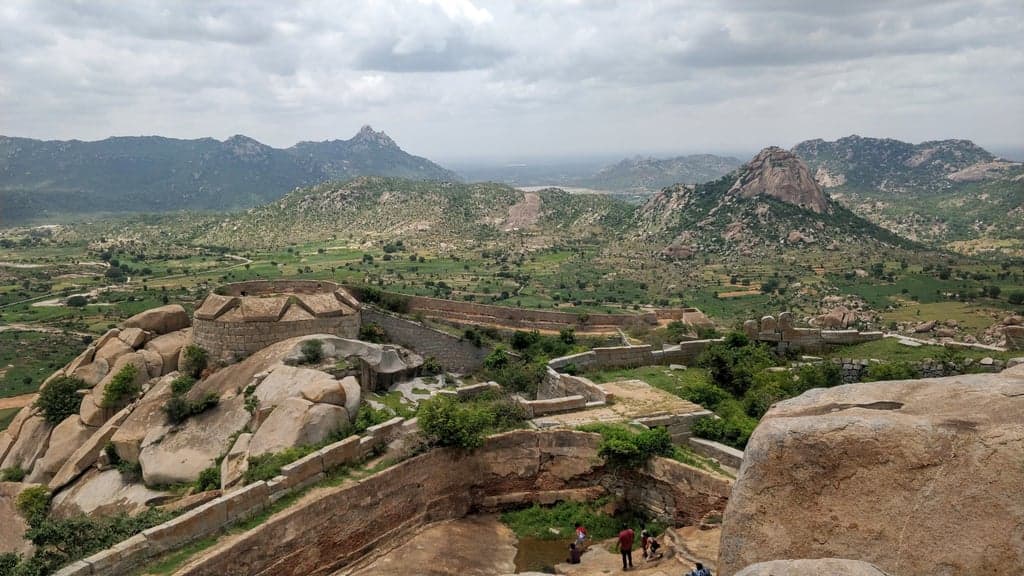
Photos from The Navadurga — Bangalore's Nine Hill Forts (+ Madhugiri, Devanahalli & More)
Destination Guide
Rajasthan
Jaipur, Jodhpur, Jaisalmer, Udaipur — a destination guide to Rajasthan's desert circuits. Where to base yourself, how long to go, and what the forts actually feel like.