Prinsep Ghat Timings, Entry & Best Time to Visit (Kolkata, 2026)
Prinsep Ghat has a specific quality on a February morning — empty ghats, the Hooghly carrying a light mist, and the kind of quiet that Kolkata almost never offers. I was back this February, up early, and walked the stretch before the city caught up with the day. The monument glowing pale in the morning light, a few joggers, a chai-wallah setting up. By 9 AM I was already at Park Street, Flurys just opening, the city slowly warming up around me. It's a combination that's deeply Kolkata — and I'd do it again every visit.
Prinsep Ghat has been part of my Kolkata for a long time. Since college, I'd come here with friends, with a camera, sometimes alone. Sitting by the riverfront, watching the boats, catching the evening light over Vidyasagar Setu. It's the kind of place that doesn't demand anything from you.
The James Prinsep Memorial
The Prinsep Ghat was built in 1841 along the banks of the Hooghly, in memory of Anglo-Indian scholar James Prinsep. For a long time it was just a lovely white monument on the bank — a popular spot for locals, and the point where dignitaries once disembarked when they arrived in Calcutta.
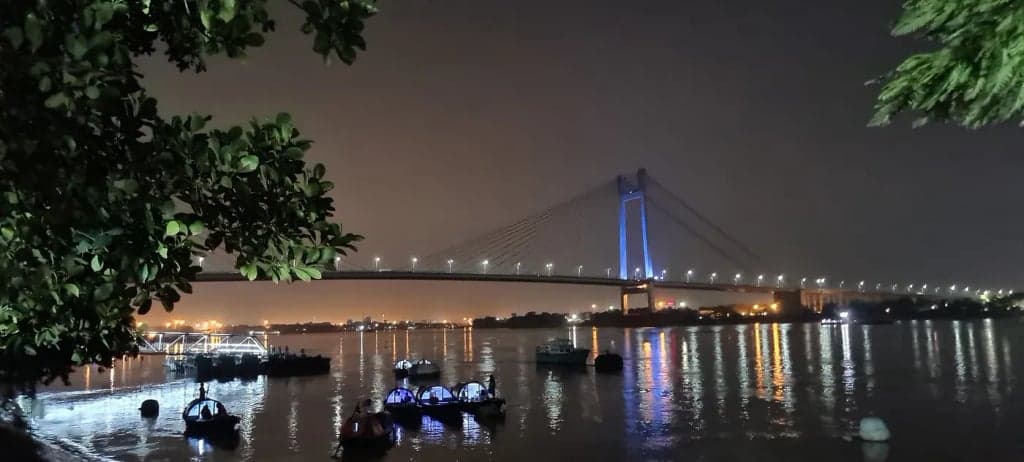
As you enter, the monument rises ahead of you with the second Howrah Bridge in the background. After sunset, both are lit up and there's something quietly theatrical about the light on the river. Walking further in, you'll catch the soft tunes of Rabindra Sangeet drifting from the speakers — a recent addition, and one of those rare instances where piped music actually earns its place.

Who Was James Prinsep?
James Prinsep arrived in India in 1819 at the age of 20. He became Assay-master of the Calcutta Mint, founded the Journal of the Asiatic Society of Bengal, and — most remarkably — deciphered the ancient Kharosthi and Brahmi scripts of India. In a short life he covered art, science, architecture, and numismatics. The ghat named after him is also commonly written as Princep Ghat — both spellings refer to the same place.
During his time in Benaras (Varanasi), he created an accurate map of the ancient city, helped design its drainage system, and restored Mughal-era minarets in decay. In Calcutta, he continued work on a canal connecting the Hooghly to the Sundarbans. When he died at 40, citizens raised a public fund of Rs. 12,000 to build this memorial. The white marble building is a clean example of Greek and Gothic architecture with Indian influences. It was carefully restored in 2001 without losing its original character.
Shooting the Hooghly — A Personal Chapter
During my college years, when I was just beginning to work with a camera seriously, Prinsep Ghat and the Hooghly became a kind of practice ground. The riverfront rewarded patience — long shots, night scenes, the geometry of the bridge and the water. I spent a lot of evenings here experimenting with composition and low-light techniques.
One of my most satisfying early shots came from here. I'd set up for the long exposure — Aperture ƒ/14.0, Shutter 13 sec, ISO 100 — and waited. The result matched what I'd imagined. That still means something.

Long exposure at Prinsep, 2012 — ƒ/14.0, 13 sec, ISO 100
The Hooghly Riverfront Walk
The banks of Kolkata have been through a proper renovation. What was years of neglect became, gradually, one of the better walkways in the city. From Prinsep, a 4km stretch runs all the way to Howrah Bridge — past Babughat, Millennium Park, old clubs, jetties, and a scatter of eateries along the way.
The walkway is clean, reasonably maintained, and tells you more about Kolkata than most tourist trails do. Walk it on a cool morning if you can — the February light over the river is worth the early start. Hot summer evenings with reluctant friends: technically possible, not recommended.

After the Ghat: Park Street and Flurys
This February, after the morning walk, I drove over to Park Street — ten minutes from Prinsep, a different Kolkata entirely. Flurys opens early enough that you can walk in off the street and sit down to a proper breakfast: scrambled eggs, toast, coffee that's actually hot. The place has been on Park Street since 1927 and manages to feel neither frozen in time nor trying too hard to modernise.
It's a combination I'd recommend without reservation: an empty Prinsep at 7 AM, the walk along the river, then Flurys by 9. You've done more of real Kolkata in those two hours than most day trips manage in a full day. If you're visiting during Durga Puja, add the pandal walk to the itinerary — the city transforms entirely and Prinsep takes on a different mood in the festive light.
Making an Evening of It
If you're here in the evening rather than the morning, the sequence I'd suggest: take a cab to the South Park Street Cemetery first — one of the oldest colonial cemeteries outside Europe, genuinely atmospheric in the late afternoon light, and largely overlooked by visitors. Victoria Memorial and St. Paul's Cathedral are close by too if you want to stack more into the afternoon. Give the cemetery an hour, then cab back to Prinsep for sunset.
The distance between the cemetery and Prinsep looks walkable on a map; it isn't comfortable in practice — take the cab.
After sunset, the food stalls along the ghat and the walkway come alive — phuchka, pav bhaji, chai, the usual Kolkata evening spread. Good for a quick bite while you're still by the river. After that, two directions. Head towards Esplanade if you want the full street food chaos — rolls, kebabs, the kind of density that Kolkata does better than anywhere. Or go the other way to Park Street, which has a completely different register. Kusum's for rolls (genuinely non-negotiable), Olypub if you want something old and no-frills, Peter Cat for a proper sit-down dinner. The street has so many options that you'll spend more time deciding than eating — which is not a bad problem to have.
Getting There and a Few Practical Notes
- The ghat closes at 8 PM — plan accordingly if you want river time, not just the walkway
- No metro directly here — nearest Blue Line stations are Maidan and Park Street, both about 2 km away; a cab or auto from either takes 5–10 minutes
- There is a Prinsep Ghat suburban railway station (Circular Railway) right next to the ghat, but only a handful of local trains stop there — not the most reliable option
- From Babughat, hop on a ferry across to Howrah station to see the bridge from the river — one of the better five minutes Kolkata offers
- Entry is free
- Best time to visit: October to February, mornings for quiet, evenings for light and atmosphere
- The walkway is well-lit and safe for evening walks
- Photographers: arrive at golden hour (just before sunset) or very early morning for the best light on the monument and bridge
- Staying in Kolkata? Booking.com has a solid range of Kolkata hotels — the Park Street / Chowringhee area puts you closest to both the ghat and the evening food circuit

Prinsep Ghat is one of those places that has meant different things at different points in my life — a college hangout, a photography classroom, a February morning reset with the city still asleep. It holds up across all of them. If you're ever trying to understand what Kolkata actually feels like beyond the landmarks and the itineraries, start here, early, before the day catches up.
And if you want to go further — a day trip to the Sundarbans is the most complete opposite of a Kolkata morning you can find, just a few hours down the highway.
Related Galleries
Destination Guide
Rajasthan
Jaipur, Jodhpur, Jaisalmer, Udaipur — a destination guide to Rajasthan's desert circuits. Where to base yourself, how long to go, and what the forts actually feel like.