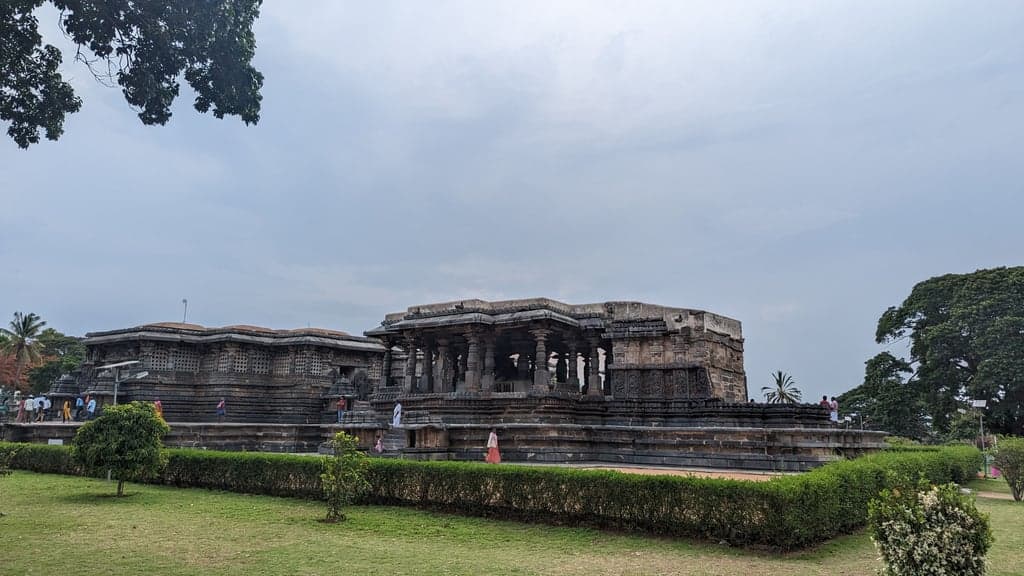
Photo essay
Hoysala Architecture Explained: Key Features, Belur vs Halebidu (Photo Guide)
A visual guide to Hoysala temples — frieze bands, Mahabharata panels, adhisthana layers, and Belur madanikas in photographs.
Hoysala architecture is soapstone that carves like butter and hardens in air — star-shaped platforms, horizontal frieze bands, and bracket figures (madanikas) under roofs that were often never finished. This photo guide walks the details in the slides: war horses scarred at Halebidu, the cavalry row, musician panels, Mahabharata scenes (Kiratarjuniya, Arjuna vs Karna, Bhima and the elephant), the stacked adhisthana layers, miniature shikharas, and Belur's madanikas and kirtimukha niches.
Scroll to read each moment.Each moment is image and caption side by side.
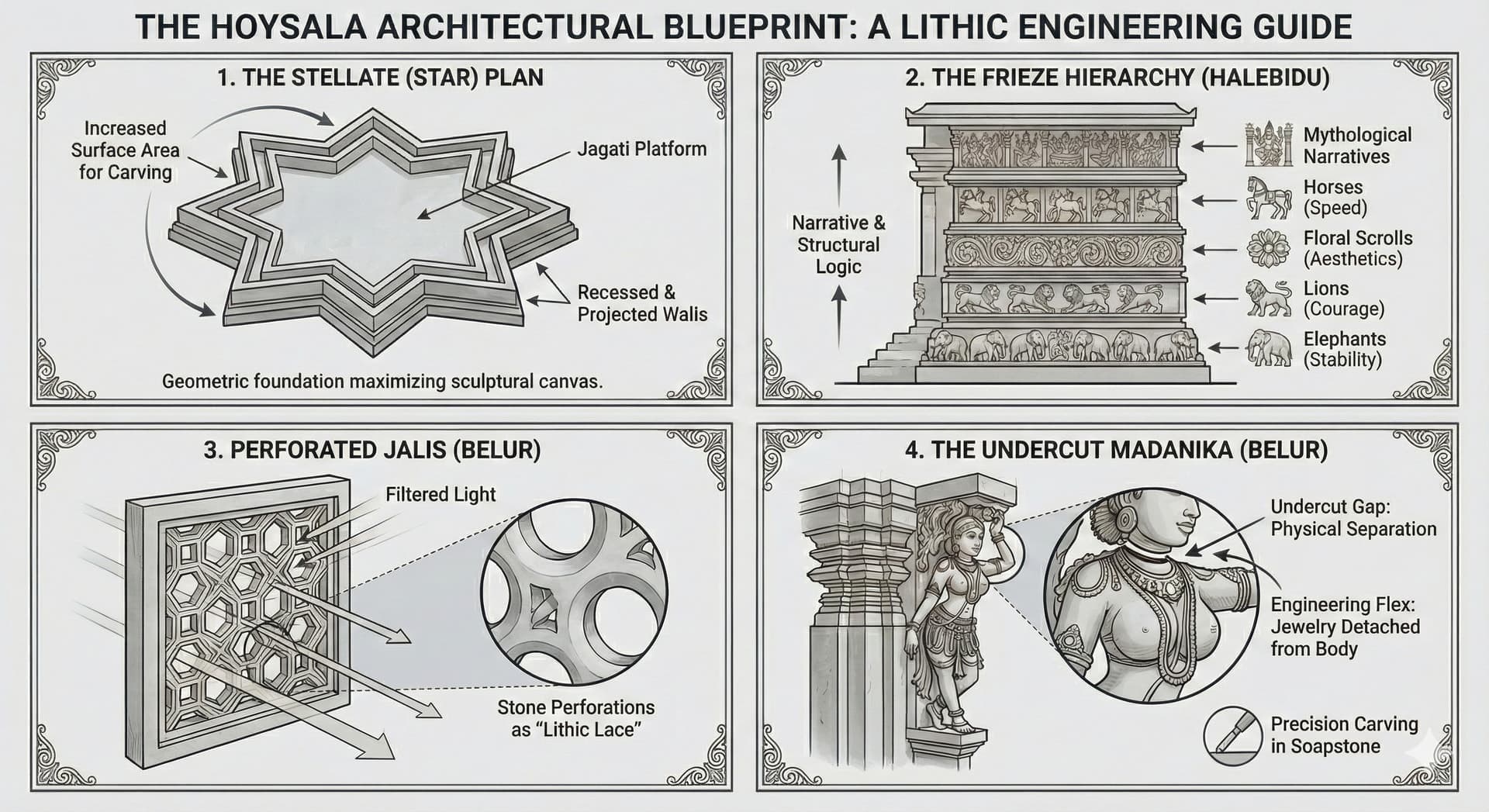
Decoding the Divine: A Guide to Hoysala Architectural Mastery
A visual breakdown of Hoysala architectural genius—star-shaped plans, narrative friezes, perforated stone screens, and precision-carved madanikas that turn soapstone into storytelling.
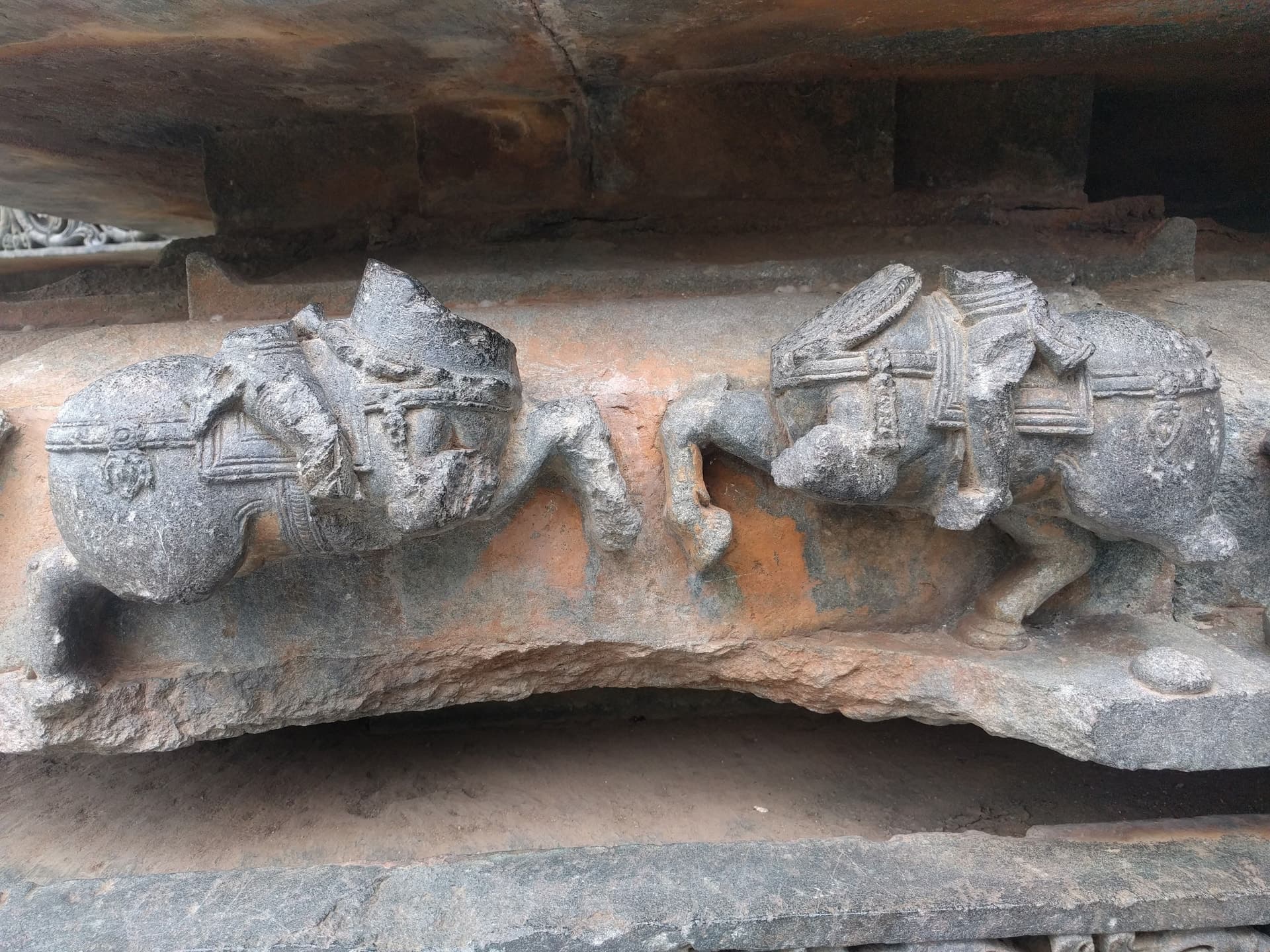
Beauty in Ruins: The Broken Charge of Halebidu
They were carved to charge eternally, but history intervened. These exquisite war horses bear the violent marks of the 14th-century invasions that decimated the city of Dwarasamudra (now Halebidu, the "Old City"). Despite the deliberate mutilation of the soft soapstone, the incredible energy and artistry of the Hoysala sculptors still shine through the centuries of scars.
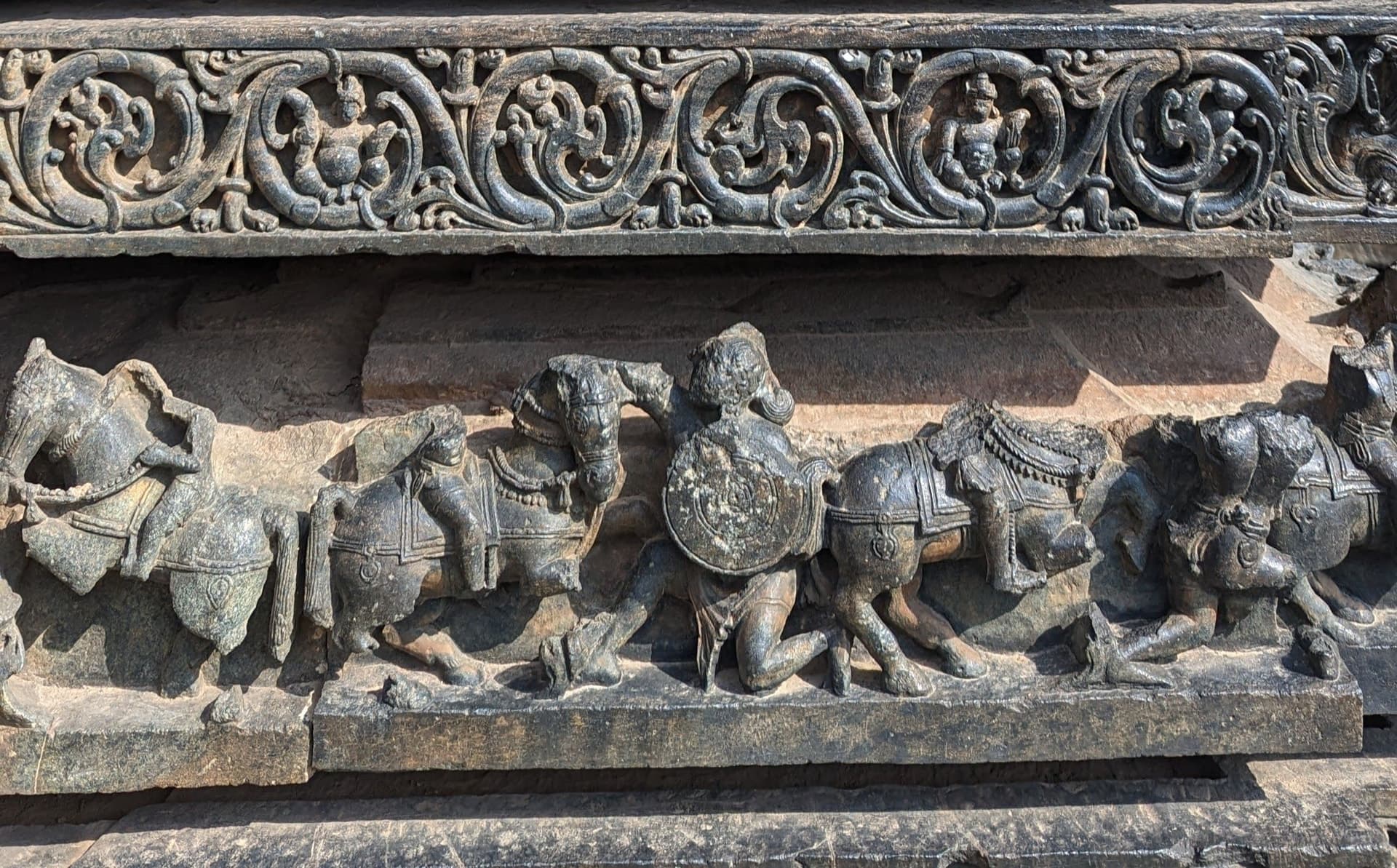
The Cavalry Row (Ashvathara): A Study in Speed
This frieze is one of the standard horizontal bands decorating the exterior base of Hoysala temples. It depicts a procession of cavalry horses in various active poses, accompanied by an infantryman holding a large circular shield. Symbolically, this layer represents speed, serving as a vital "foundation" layer alongside the rows of elephants (representing strength) and lions (representing courage) typically carved below it.
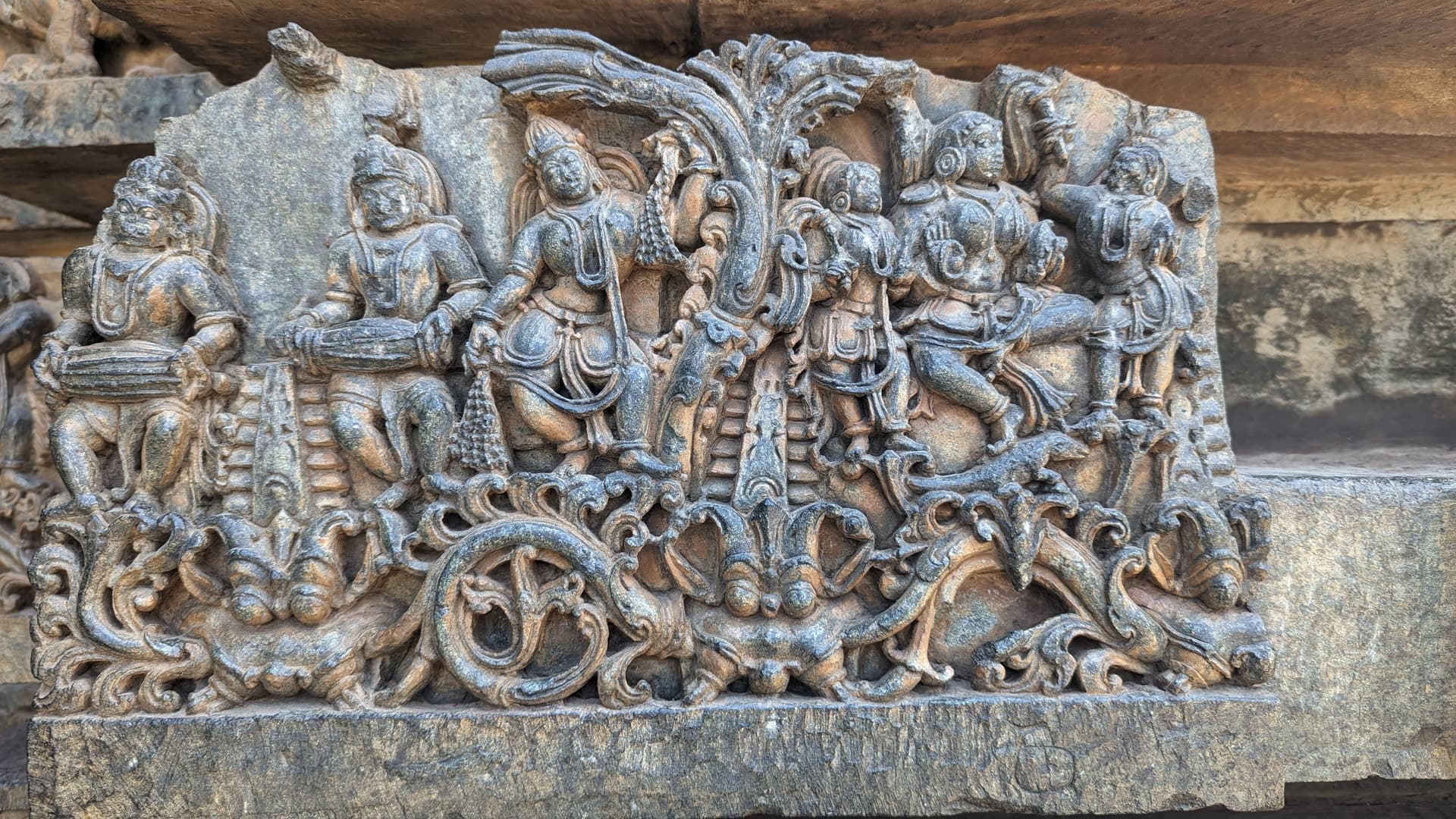
The Divine Ensemble: Musicians and Dancers
This panel portrays the refinement of 12th-century arts, featuring a central dancer accompanied by a full musical troupe. You can clearly see musicians playing the mridangam (horizontal drum) on the left and a flutist on the right. This layer is typically placed higher up the temple plinth than the animal rows to symbolize the elevated nature of human culture and religious devotion.
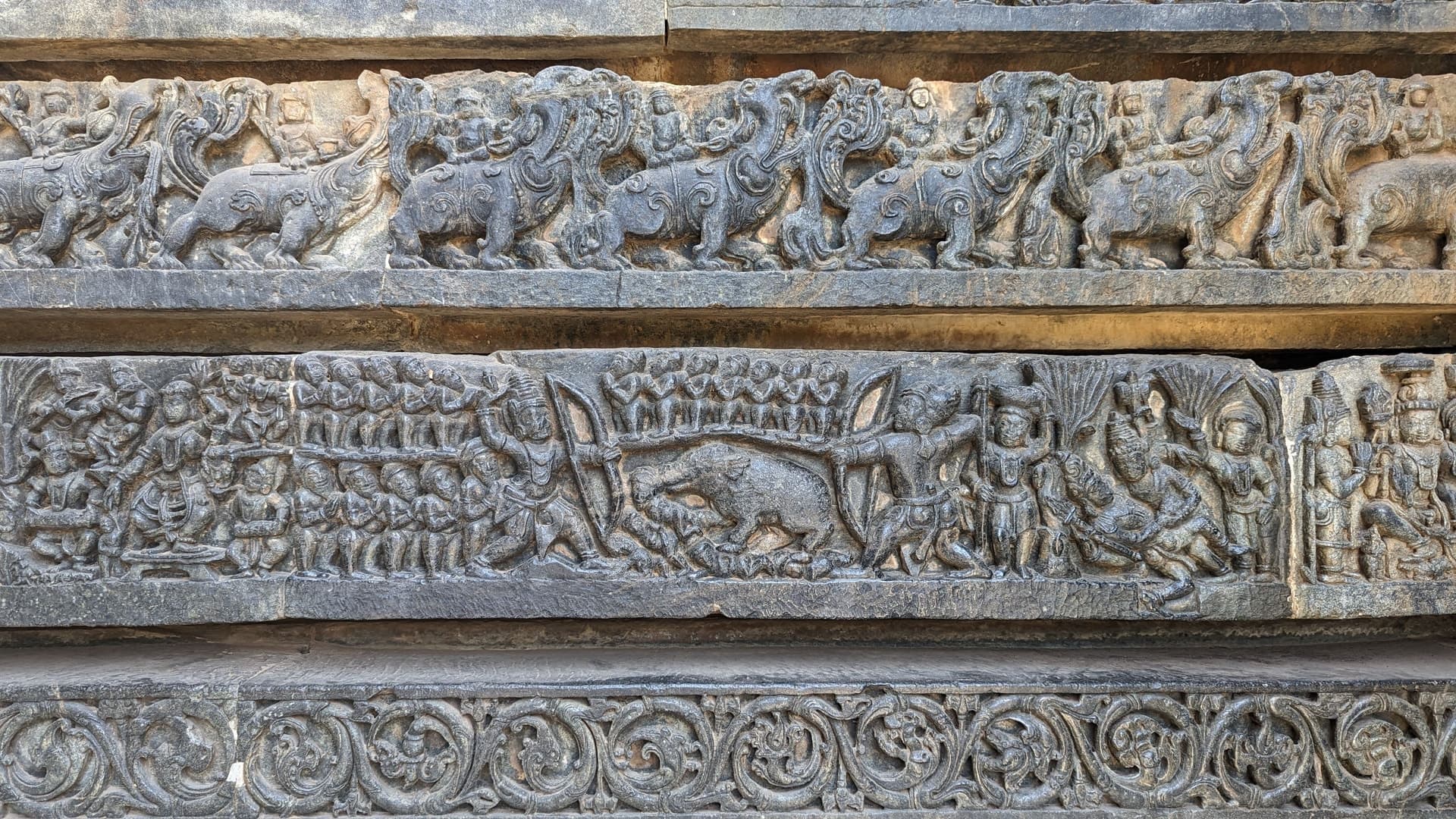
The Kiratarjuniya: Arjuna’s Duel with Lord Shiva
This Hoysala stone relief depicts a famous episode from the Mahabharata where Arjuna and Lord Shiva (disguised as a Kirata or hunter) simultaneously shoot a demon disguised as a wild boar. The carving captures the moment of the dispute over the kill, which leads to a duel where Shiva tests Arjuna’s merit before gifting him the divine Pasupata Astra weapon.
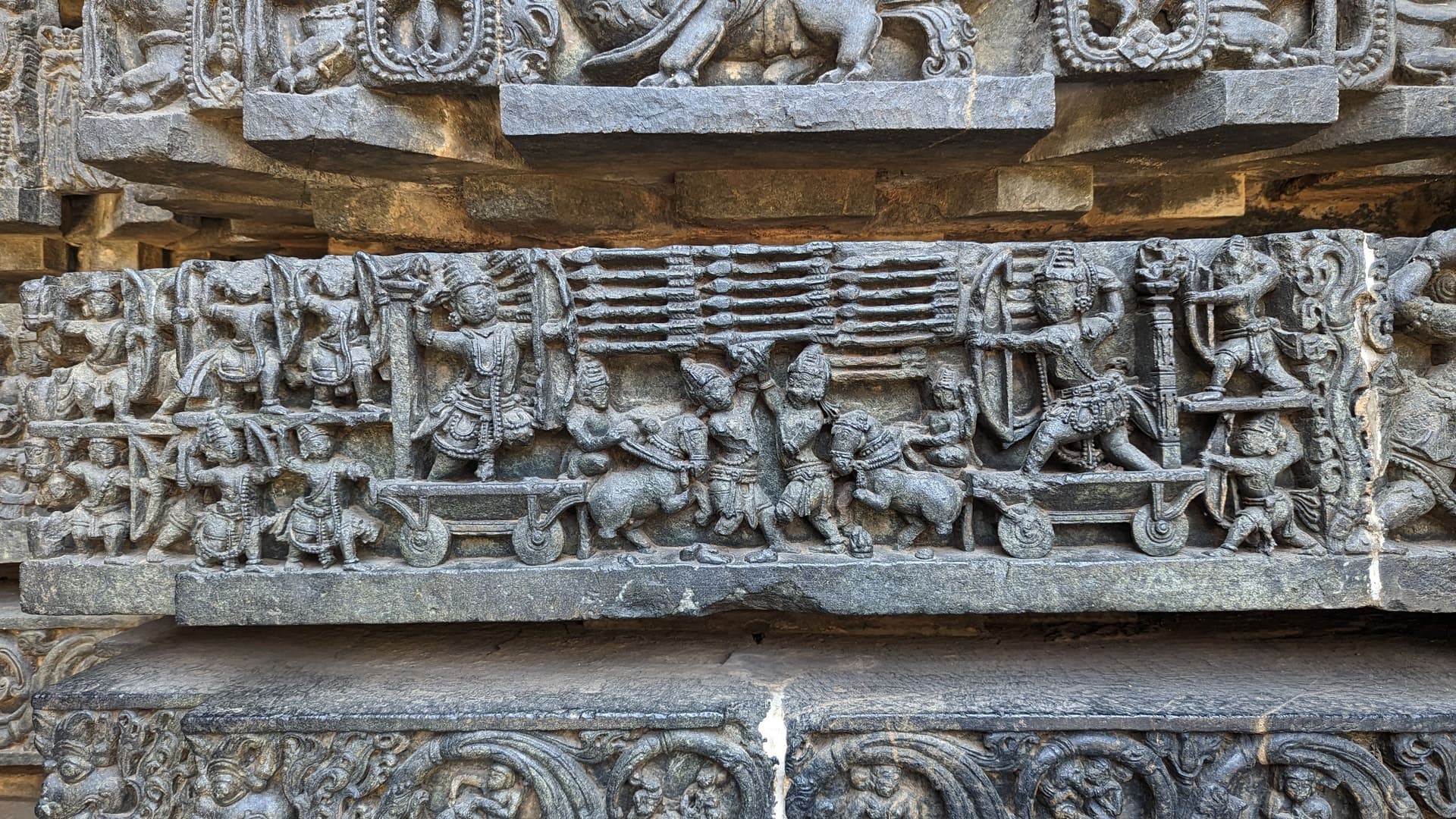
Battle of Kurukshetra: Arjuna vs. Karna
his intricate narrative frieze depicts the climatic duel between Arjuna and Karna. They are shown on opposing chariots, identified by their unique flag emblems, firing a barrage of arrows at one another in the middle of the battlefield.
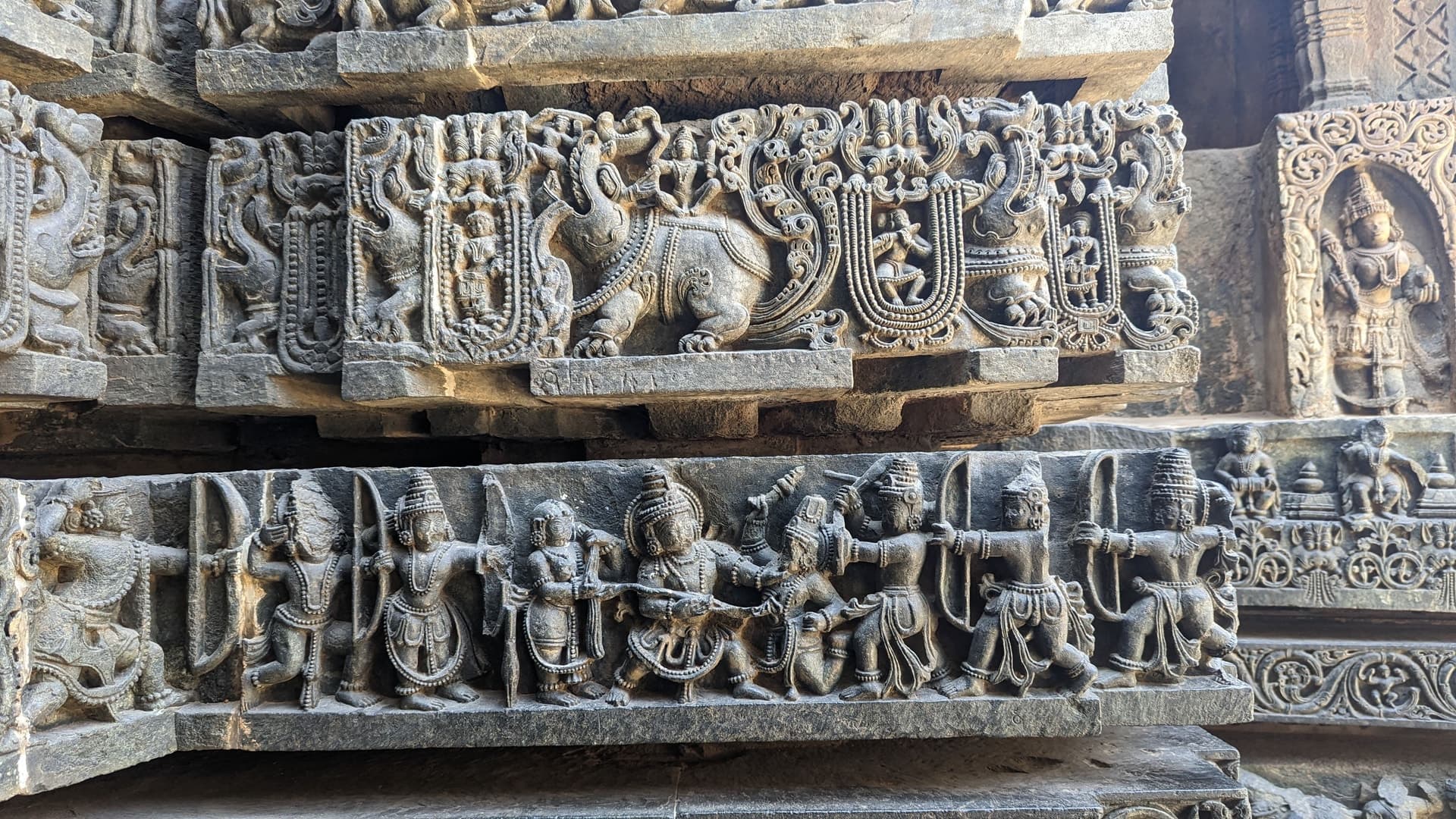
Bhima Slaying Bhagadatta’s Elephant
A dynamic scene showing the Pandava hero Bhima attacking the massive war elephant, Supratika, belonging to King Bhagadatta. The carving captures the sheer scale of the elephant and the intensity of the specialized infantry tactics used to bring it down.
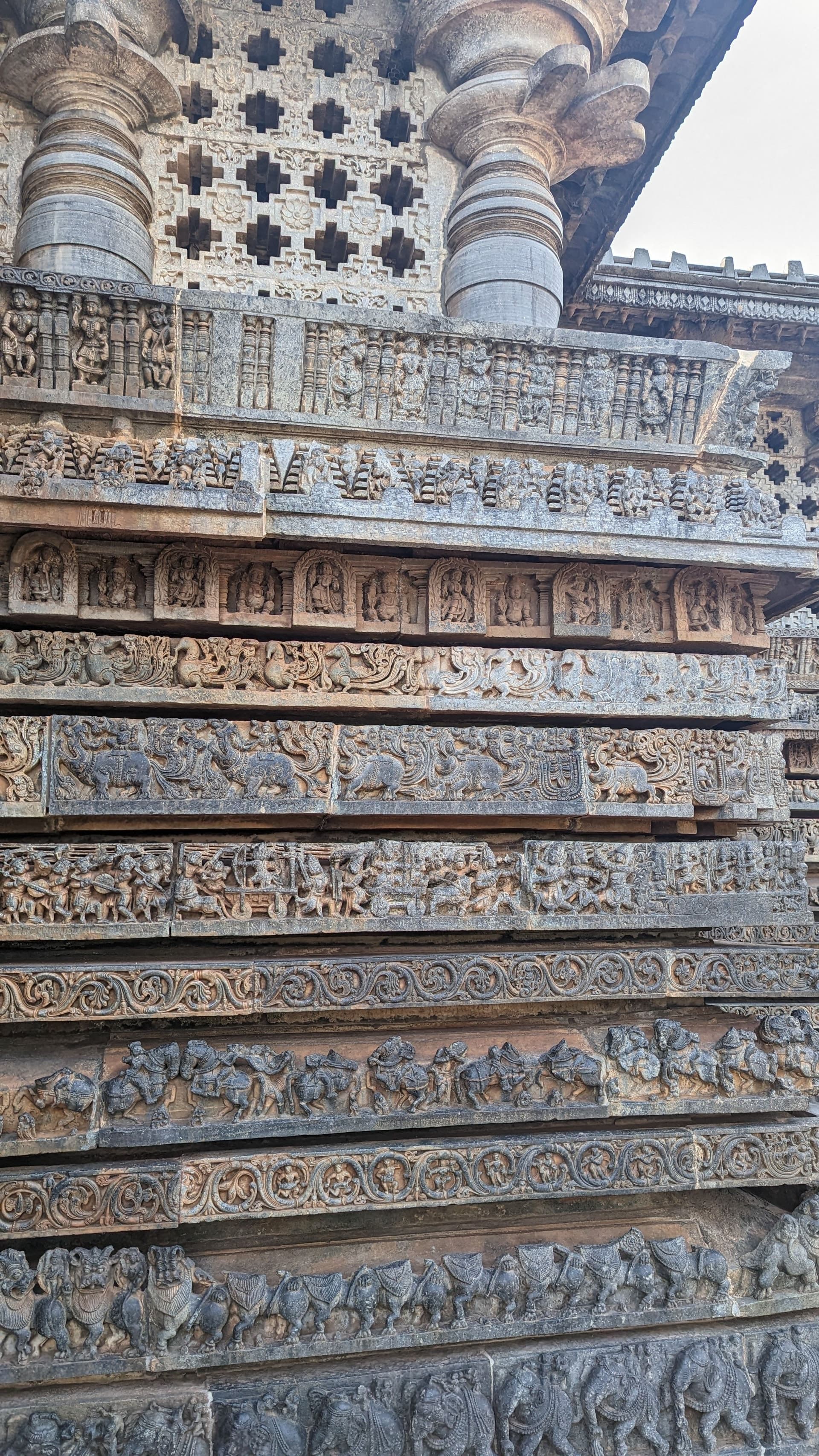
The Adhisthana: Layered Narratives of the Temple Base
This view shows the six to eight stacked layers characteristic of Hoysala temples. From bottom to top, the layers typically represent a hierarchy: Elephants (strength), Lions (courage), Vines (beauty), Horses (speed), and finally Epic Narratives from the Ramayana and Mahabharata.
The adhisthana slide is the Rosetta stone — six to eight horizontal registers, each with a job: elephants, horses, foliage, then myth. Read one column bottom to top and the rest of the temple stops being decoration and starts being a programme.
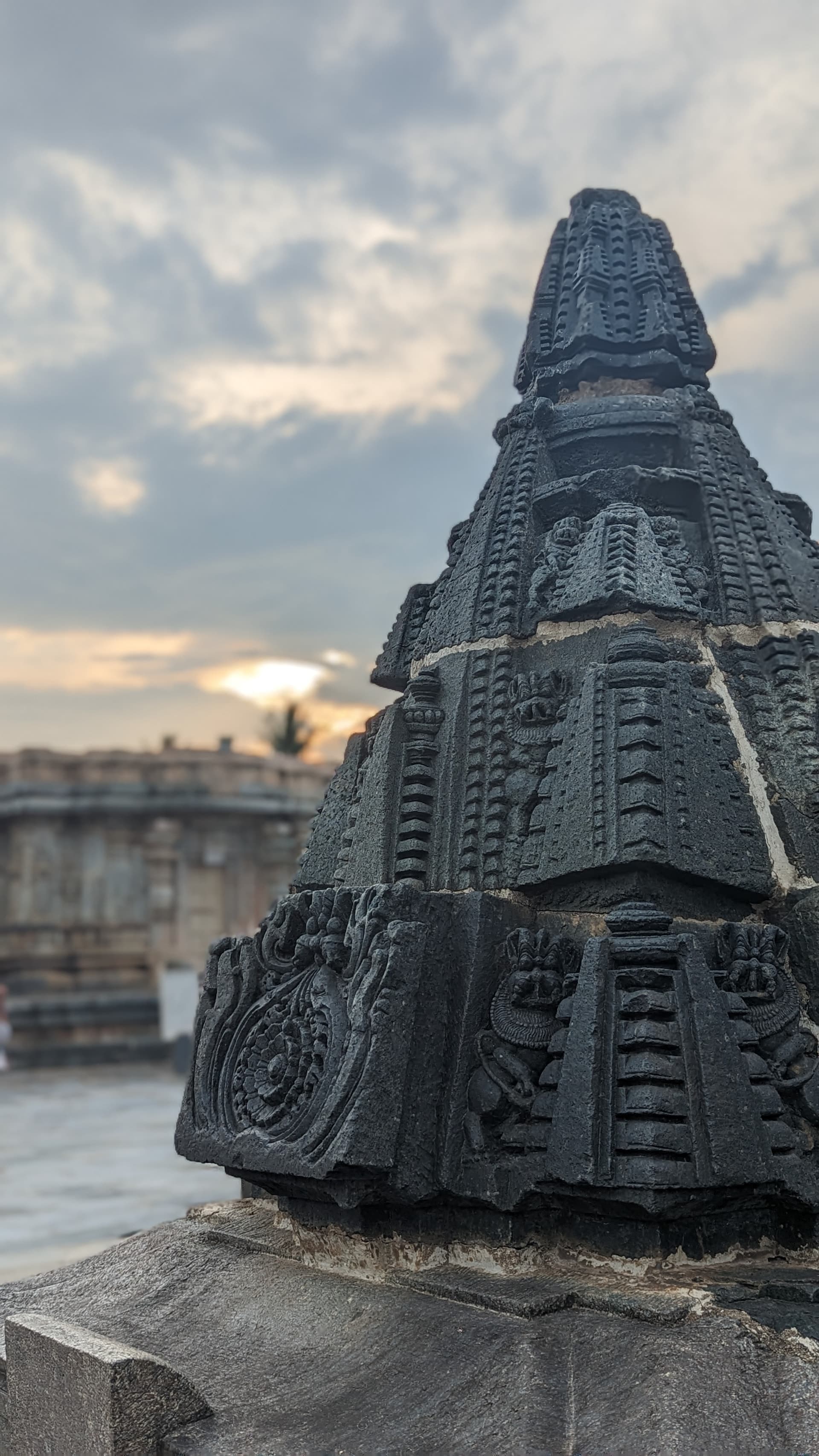
Masterpieces in Soapstone: The Intricate Details of Hoysala Art
A close-up view of a miniature shikhara (tower) showcasing the legendary precision of 12th-century stone carvers. The dark chloritic schist stone allows for a level of detail that has survived centuries of weathering, standing firm against a dramatic evening sky. || Google Pixel 7 — 7mm • ƒ/1.9 • 1/1953 • ISO 46
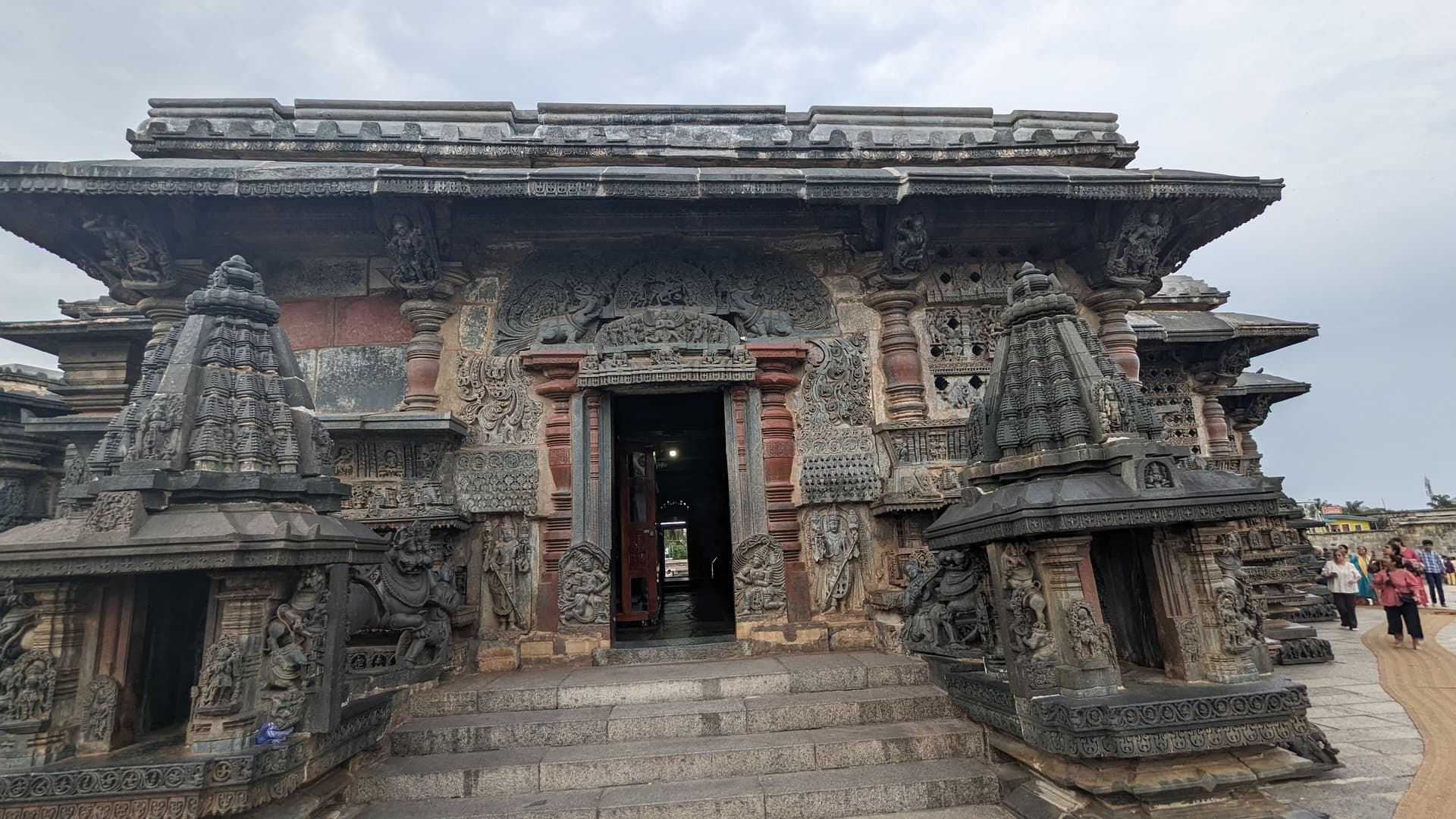
A Living Monument: Exploring the Wonders of Belur
A wide-angle view of the temple's main entrance, flanked by two exquisite miniature shrines. From the intricately carved Makara Torana (lintel) above the doorway to the life-sized guardians and delicate stone lattices, every inch of the soapstone facade is a testament to the skill of 12th-century artisans.
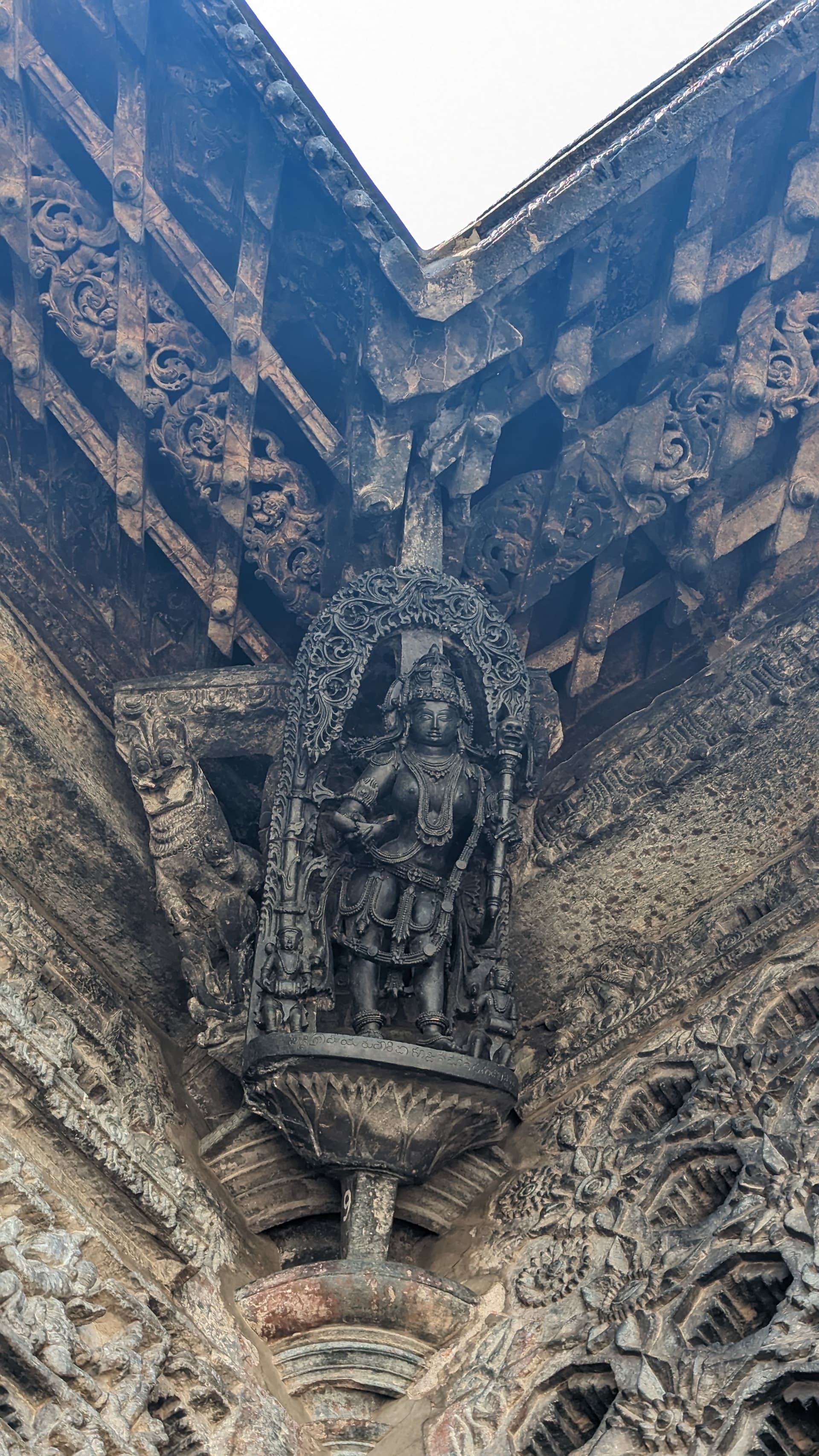
Celestial Beauty: The Madanikas of Belur
A close-up of a Madanika (bracket figure) nestled under the temple eaves. These figures represent the feminine ideal and are world-renowned for their lifelike poses, detailed jewelry, and the high-polish finish achieved on the chloritic schist (soapstone).
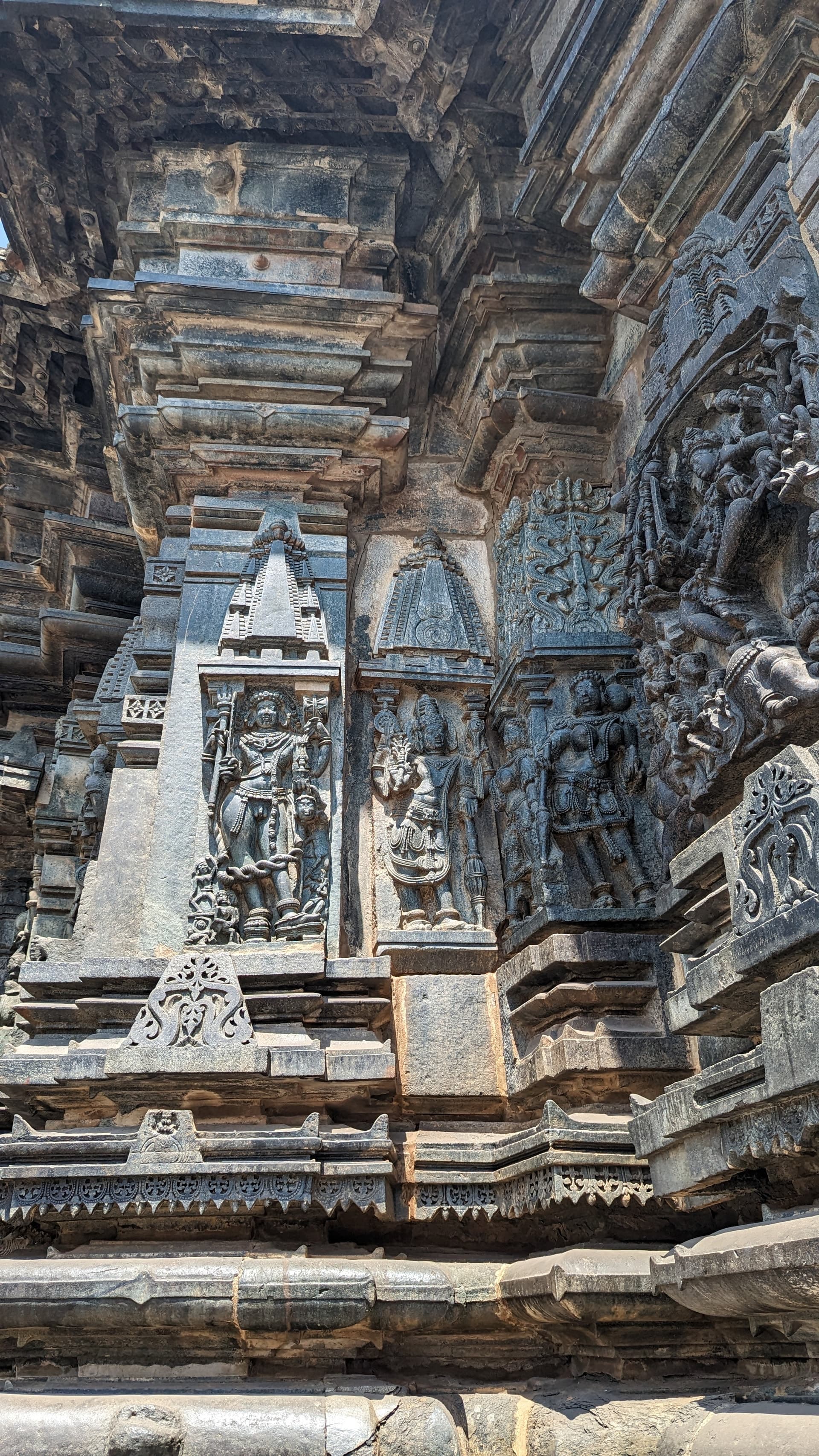
A Pantheon in Stone: Divine Figures and Miniature Spires
This section of the exterior wall displays high-relief carvings of deities sheltered by miniature shikharas (towers). The sharp, geometric lines of the stone molding contrast with the soft curves of the divine figures, demonstrating the technical mastery required to carve such deep textures into chloritic schist.
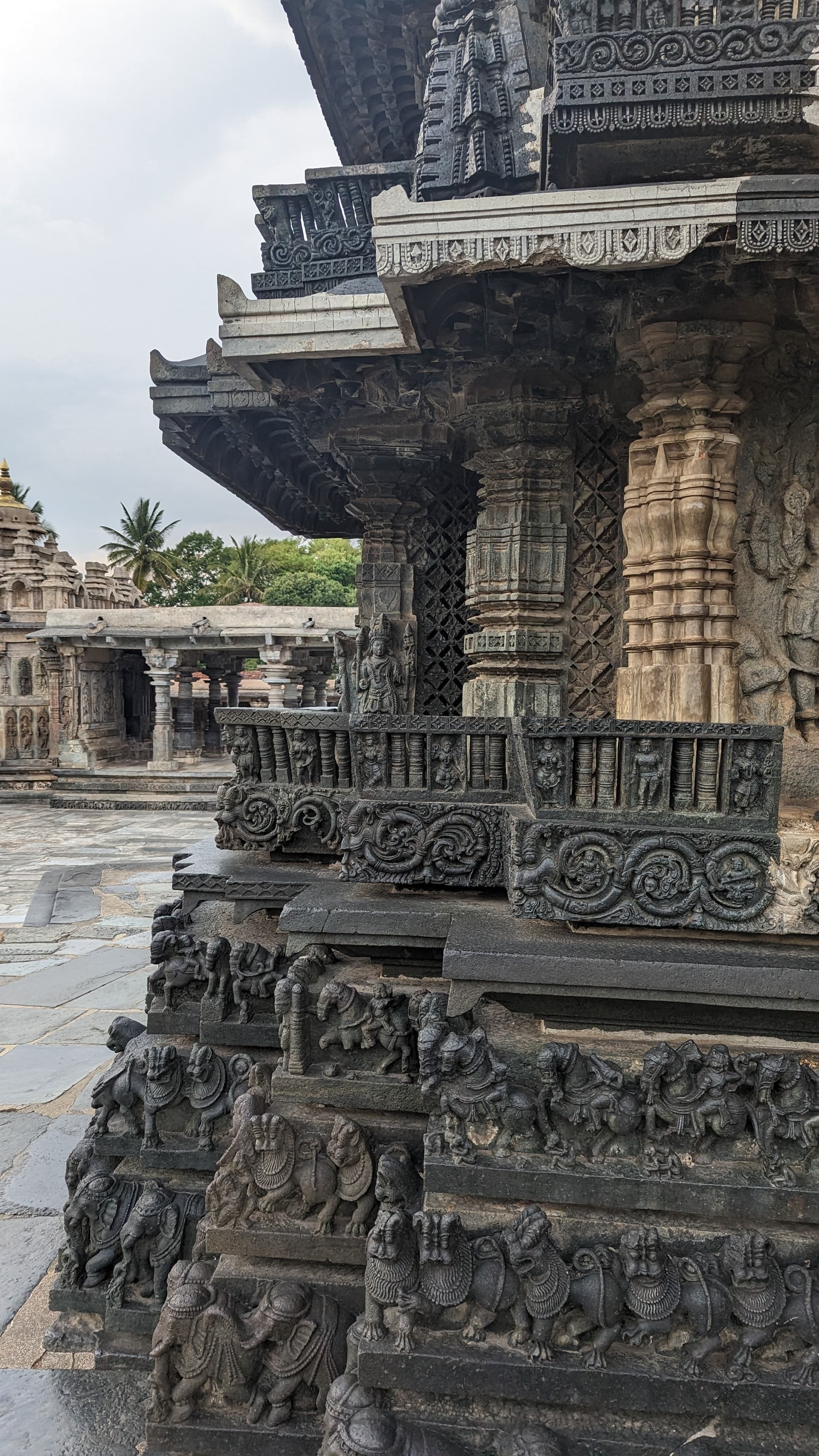
Layers of Life: The Horizontal Friezes of the Base
Looking up from the temple's base, one can see the meticulously carved horizontal bands. Traditionally, these friezes depict a hierarchy of strength and stability: elephants at the bottom for power, followed by lions for courage, and horses for speed, creating a narrative foundation for the temple walls.
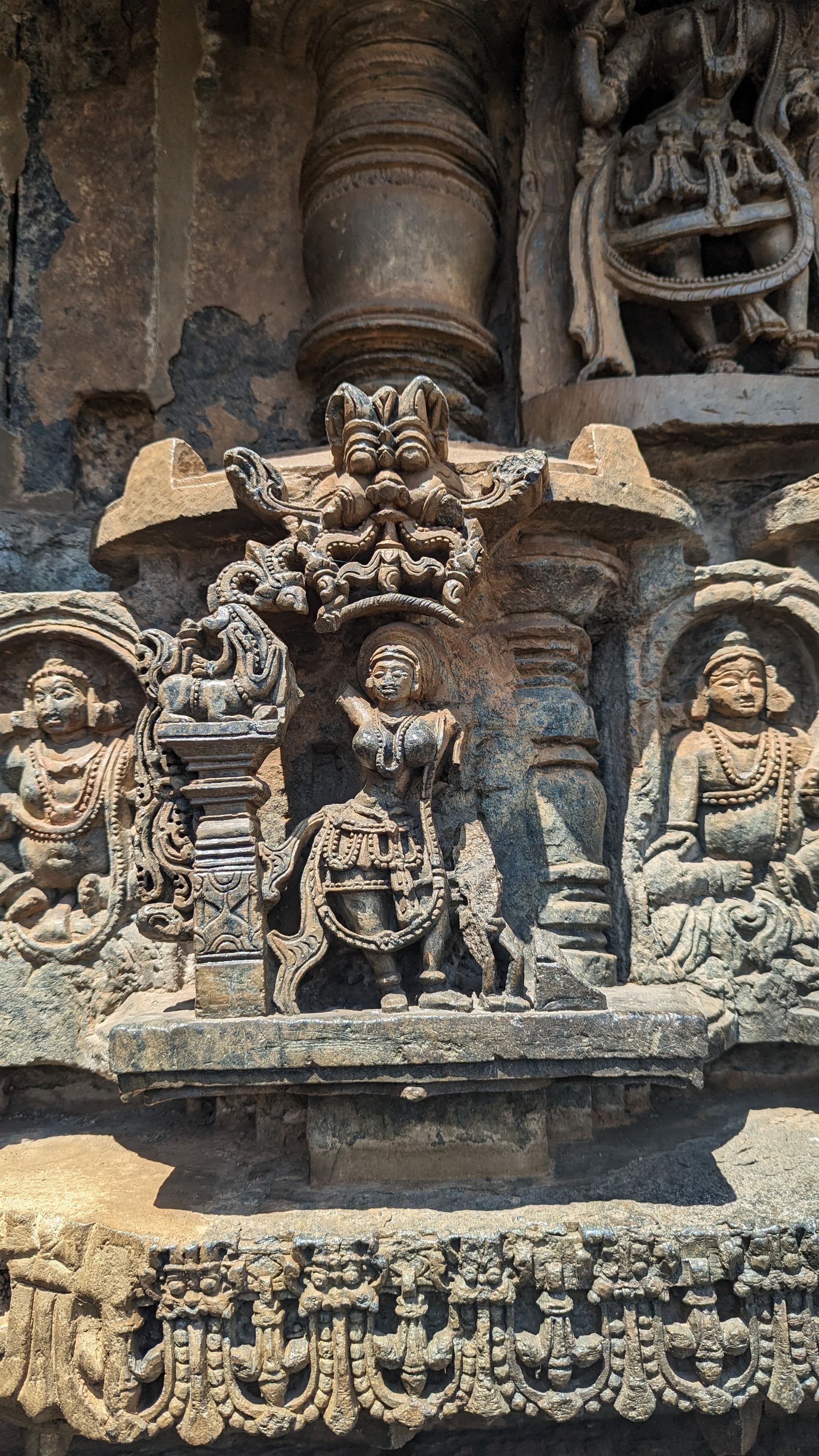
The Guardian's Gaze: Niche Sculptures and the Kirtimukha
A detailed look at a wall niche featuring a central figure crowned by a Kirtimukha (Face of Glory). These motifs are designed to ward off evil and protect the sanctity of the temple, illustrating the deep symbolic layers embedded within every inch of the architecture.
Quick reference
| Panels in this guide | War horses (Halebidu) · Cavalry row · Musicians · Kiratarjuniya · Arjuna–Karna · Bhima & elephant |
|---|---|
| Belur highlights | Madanika bracket figures · Kirtimukha niches · Main entrance miniature shrines |
| Halebidu note | Damaged horse frieze — history visible on the stone |
| Key sites | Belur Chennakesava · Halebidu Hoysaleswara (~16 km apart) |
| From Bangalore | ~220 km via Hassan · long day for both sites |
| Material | Soapstone (chloritic schist) — lathe-turned pillars inside, narrative bands outside |
Common questions