Ooty Travel Guide: The Nilgiris Without the Crowds (Weekend from Bangalore)
The Nilgiris Still Have Magic — If You Know Where to Look
Ooty has a reputation problem.
Ask anyone who went in May and you'll hear the same thing: traffic from Mettupalayam, a lake surrounded by paddle boats, overpriced hotels, and a toy train you waited two hours to board. And yet, somehow, people keep going back. And so do I.
Because underneath all of that — beneath the tourist buses and the boiled sweets shops and the Instagram-famous rose gardens — there is a hill station that earns its fame. You just have to be a little strategic about it.
This guide is for the Bangalore traveller planning a long weekend escape. It covers Ooty properly, and tucks in Coonoor, Kotagiri, and Lovedale — three places most visitors drive past without stopping. Don't make that mistake.
Before you go: Ooty now requires an e-pass for all tourist vehicles — both Tamil Nadu and non-TN registered. Apply at epass.tnega.org before your trip. It takes a few minutes online and saves a headache at the entry point.
Why Ooty in Summer Makes Perfect Sense (Even If Everyone Else Thinks So Too)
Bangalore in April and May is a city in distress. The temperature climbs, the air turns thick, and every afternoon feels like a punishment. Ooty, sitting at 2,240 metres in the Nilgiri hills, is the obvious answer — and the fact that it's obvious doesn't make it wrong.
The best long weekends to use for this trip in 2026:
- May 1 (Labour Day, Friday): A clean 3-day weekend. The hill station is at full capacity by now — book early and arrive before Friday afternoon.
- June long weekends: The monsoon arrives and the Nilgiris go green and quiet. Fewer tourists, lower prices, and a completely different mood. Not for everyone, but worth knowing about.
- Any long weekend October–November: Post-monsoon clarity, cool air, and the tea estates at their most photogenic. The best time to go if you have flexibility.
The trick with Ooty in summer is not to avoid it — it's to arrive early and leave the main town quickly. The crowds concentrate around Ooty Lake, the botanical garden, and the bazaar. Everything beautiful about the Nilgiris is outside those three spots.
Getting There: Bangalore to Ooty
Distance: ~270 km
Drive time: 5.5–6.5 hours
Best route: Bangalore → Mysore Expressway → Mysore bypass → NH 181 → Gudalur → Ooty
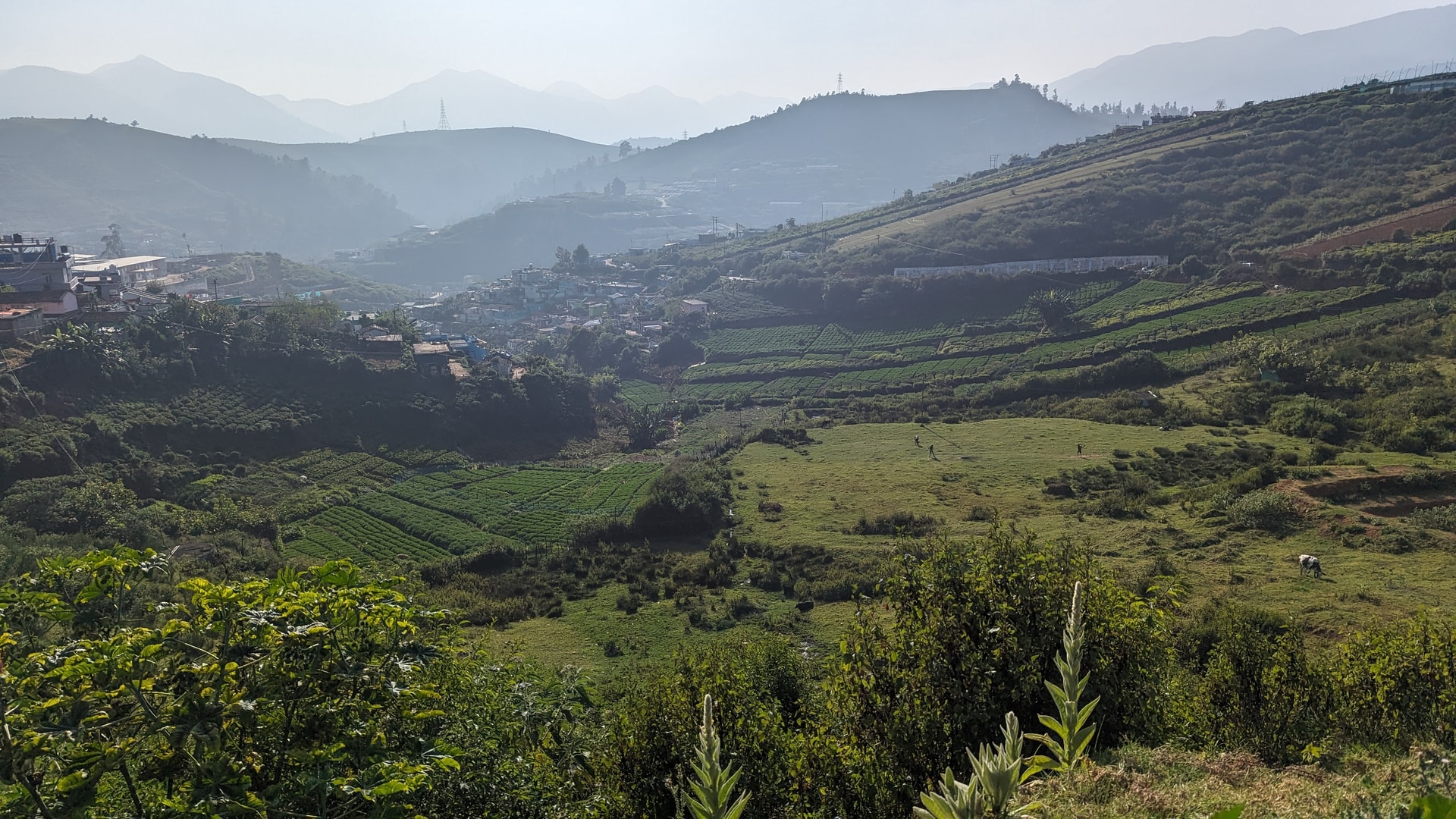
The Mysore Expressway makes the first 140 km smooth and fast. After Mysore, the road narrows and the real drive begins. Keep your eyes open around Gundlupet — depending on the season, the fields on either side go completely yellow with sunflowers, and it's the kind of thing that makes you pull over without planning to. From there it's past Nagarhole's fringes, through Gudalur, and then the climb up the Nilgiri ghats: tea estates terraced up the hillside, mist rolling in from the valleys, eucalyptus forests lining the road.
Leave by 5 AM. Not because of traffic (though that's also true), but because arriving at Ooty before 10 AM means you get the town before it wakes up properly. The morning light on the Doddabetta range, with a cup of tea from a roadside stall, is worth the early alarm.
Route note — Mudumalai shortcut: All LMVs are allowed up through Mudumalai, but only Ooty-registered vehicles are permitted to come down that way. Which means this shortcut is one-way for most people — useful going up, not available on the return. Google Maps doesn't always know this and will confidently route you through Mudumalai on the way back. Don't follow it. Factor in an extra hour on the return via Gudalur and Mysore. The Mudumalai climb itself is steep and full of hairpin bends — rewarding, but not one to attempt tired or in a hurry.
Coming back — alternate routes worth considering:
The default return is via Gudalur and Mysore — add roughly an hour over the drive up, and plan accordingly. If you have the appetite for something longer, the Erode–Salem corridor is worth it — wider roads, a different slice of Tamil Nadu, and a less rushed return. Or push into Karnataka via the Talamalai Ghat or through the Cauvery Wildlife Sanctuary corridor, particularly good if it's been raining. The forest and countryside on that stretch in the wet are worth the extra hours.
Recommended Stops on the Way Up
- Gudalur town: Good breakfast stop before the ghat climb. Simple South Indian meals — idli, vada, filter coffee.
- Kalhatty Waterfalls viewpoint: About 13 km before Ooty, easy to miss. Stop and stretch.
- Nagarhole / Kabini fringes (optional): If you have time the evening before, base near Kabini and drive up to Ooty the next morning. Makes for a beautiful two-act trip.
Where to Stay: Four Bases, Four Different Trips
The Nilgiris is not a place with one obvious base. I've stayed across the range — in Ooty town, Kotagiri, and Lovedale — and the difference between them isn't just about proximity to sights. It's about what kind of Nilgiris you're after. Here's how to think about each.
Ooty Town
The most convenient base if you want to walk to things, catch the morning market, and be central. The area around Charing Cross and Upper Bazaar has decent guesthouses and a handful of colonial-era hotels. If you're on a short trip or travelling with family, the convenience wins. The kind of stay to look for here is a heritage bungalow conversion — wood-panelled rooms, four-poster beds, breakfast served in a dining room that looks like it hasn't changed since 1960. They exist, and they're the right way to do Ooty town.
One honest caveat: Ooty rewards early mornings and punishes late risers. By 10 AM in peak season the traffic alone changes the character of the place. Get out early, return late.
Where I stayed: 02 Blue Room — a bungalow-style room in Ooty town that did exactly what I needed: central, comfortable, no fuss.
Coonoor
About 19 km from Ooty, sitting at 1,850 metres, and consistently quieter than its more famous neighbour. Coonoor has what Ooty used to have before it was properly discovered: colonial bungalows converted into homestays, tea estate walks you can do without a guide, a bazaar where prices haven't been calibrated to tourist tolerance. It's the right base if atmosphere and quiet matter more than convenience. Lamb's Rock, Droog Fort, Highfield Tea Estate — all better accessed from here than from Ooty town.
Kotagiri
The one the crowds haven't found yet, and probably won't for a while. Kotagiri sits on the eastern edge of the Nilgiri plateau, lower than Ooty and Coonoor, drier, and genuinely unhurried. The tea estate walks here are less managed than the ones near Coonoor, and Kodanad viewpoint — looking east over the Mysore plateau — is one of the finest in the range. A fundamentally different perspective than the Ooty-side viewpoints, which all face west into the Ghats. Worth choosing if you've done Ooty and Coonoor before and want to go deeper.
Where I stayed: Nilgiris Calling — a family property set in a carpet of green with forest on the fringes and the occasional Indian Gaur coming through at dusk. The hosts cooked for us. The deck faced the sunrise. Nothing was curated. A completely different register from anything in Ooty town.
Lovedale
Most people don't know Lovedale exists. It's a small settlement about 6 km from Ooty toward Wellington, sitting at around 7,500 feet, and the Nilgiri Mountain Railway passes right through it. The valley below fills with mist in the evenings, tea bushes run up the slopes on every side, and the deliberate absence of tourist infrastructure is the whole point. Not a base for ticking things off. A base for sitting with the Nilgiris for a day and letting them do their thing. Worth it for one night of a longer trip if you can find the right property.
Where I stayed: Ku Mo — Perched in the Sky — the listing describes itself as "a haven in the clouds," and that's not marketing copy, it's just accurate. Perched on an escarpment above the Ketti Valley, you wake up to the sound of the steam engine coming through the valley below. Sunrises and sunsets over the valley, walkways through the estate. The name is Japanese for a cloud haven, and it earns it.
One thing consistent across all four: the Nilgiris rewards having your own vehicle. The sights are spread across the range, and the drives between them are part of the experience. You're on a road trip from Bangalore anyway — keep driving.
What to Actually Do in Ooty
Doddabetta Peak
At 2,637 metres, the highest point in the Nilgiris. The road up is worth the drive even if the peak gets crowded at the summit. Go before 9 AM — on clear mornings you can see across to Coimbatore, and in summer the clouds roll in by mid-morning, which is beautiful in its own way. The telescope house at the top is a tourist trap. The viewpoint beside it is not.
Ooty Botanical Garden
One of those places that somehow remains genuinely worth visiting despite being firmly on the tourist circuit. Spread across 22 hectares, with a fossil tree trunk that's 20 million years old sitting quietly in one corner. Go on a weekday morning. Avoid weekends in May — the crowd density reaches a different level entirely.
Ooty Lake
Don't plan your trip around it. It's fine. The paddle boats are there if you're with kids. The lake is manmade (built by John Sullivan in 1823), and the area around it has been thoroughly commercialised. Walk the northern bank early morning for the light on the water, then move on.
Avalanche Lake
This is what most people miss. About 28 km from Ooty town, through a forest road maintained by the Tamil Nadu Forest Department. The lake sits in a quiet valley surrounded by shola forest and tea estates — none of the infrastructure of the main town. This is the Nilgiris people imagine when they book the trip. Entry is sometimes restricted; check current status before planning.
Emerald Lake and the Wenlock Downs
The drive from Ooty toward Emerald through the Wenlock Downs is one of the finest in the Nilgiris. Rolling grasslands, tea gardens falling away into valleys, the occasional Toda settlement in the distance. No specific sight to tick off — just a road worth being on slowly.
Kodanad Viewpoint (from Kotagiri)
Most visitors miss this because it's on the wrong side of the plateau from Ooty. That's the reason to go. The view looks east over the plains — the Mysore plateau laid out below, the Biligiriranga hills on the horizon on clear days. A fundamentally different perspective on the Nilgiris than anything from the Ooty side.
Coonoor: Lamb's Rock and Droog Fort
Lamb's Rock is a viewpoint that genuinely earns the word — the Coimbatore plains spread below to the south, and on clear days you can trace the line where the Ghats end. One of those spots where you stay longer than planned.
Droog Fort is what most Coonoor visitors skip, which is a mistake. About 13 km from town, a Portuguese-era fort at the edge of a sheer cliff. The walk up through the tea estate is as good as the fort itself. Minimal tourist infrastructure means you'll likely have it to yourself.
Wellington Cantonment
A few kilometres from Coonoor, home to the Defence Services Staff College — one of the most well-maintained cantonment towns in India. The cantonment roads are open to civilian traffic; no permit needed, just drive through respectfully. The roads are immaculate, the colonial-era church and officer's mess buildings are worth slowing down for, and if you have any connection to the military, this one hits differently. Not a tourist attraction in the conventional sense, but the drive through is beautiful and carries a particular weight.
The Nilgiri Mountain Railway (Toy Train)
A UNESCO World Heritage Site. The train runs from Mettupalayam to Ooty via Coonoor — 46 km, about 5 hours, through 16 tunnels and 31 stations. It's genuinely one of the great train journeys in India.
Practical reality check: Tickets sell out weeks in advance in peak season. Book on IRCTC as early as possible. If you can't get the full journey, the Coonoor to Ooty section (~19 km) is the most scenic and easier to book. The Mettupalayam start requires an overnight from Bangalore to Coimbatore, which turns this into a longer trip. And if you're staying in Lovedale, you might just catch it passing through the valley for free.
A 3-Night Itinerary: The Nilgiris Long Weekend
Based in Coonoor — swap Kotagiri in on Day 2 if you've done Coonoor before.
Day 1: Arrive, Settle, Decompress
- Leave Bangalore by 4:30–5 AM
- Breakfast stop at Gudalur
- Arrive Coonoor by 11 AM
- Check in, slow afternoon walk around Upper Coonoor
- Lamb's Rock for sunset
- Dinner at the guesthouse or a local restaurant in town
Day 2: Tea Country
- Morning: Highfield Tea Estate tour
- Drive to Droog Fort — take the walking trail if weather permits
- Afternoon: Wellington Cantonment drive
- Evening: Celeste by Mindescapes — book for sunset
Day 3: Ooty Day
- Early drive to Ooty (40 mins)
- Botanical Garden before 9 AM, before the crowds arrive
- Drive toward Emerald Lake via Wenlock Downs
- Avalanche Lake if open and accessible
- Return to Coonoor for evening
Day 4: Doddabetta and Home
- Early: Doddabetta Peak before the clouds roll in
- Drive back via Gudalur and Mysore
- Optional: Mudumalai Wildlife Sanctuary — possible elephant sighting from the highway corridor
- Back in Bangalore by evening
What to Eat in the Nilgiris
The Nilgiris has a food culture that doesn't get the attention it deserves.
Varkey: A flaky, slightly sweet bread that has been made in Ooty's bakeries for over a century. Buy one warm from the older establishments in the Upper Bazaar area — not the packaged versions in tourist shops.
Nilgiri tea: Buy at the estate or from small shops in Coonoor town, not the tourist stalls on Ooty's main road. Nilgiri tea is lighter and more aromatic than Darjeeling or Assam, with a distinct golden liquor — but that character disappears entirely in the blended, packaged versions sold in pretty tins near the lake.
Home-cooked meals at a homestay: If you're staying at a proper Nilgiri estate — in Kotagiri especially, where the homestay culture is intact and unhurried — ask for home-cooked meals. The hosts cook, you eat with the family, and you get food specific to the region rather than a generic tourist menu. Don't skip this for a restaurant every time.
Celeste by Mindescapes (Coonoor): Worth a visit for more than the food. The restaurant sits up on the hill with one of the better sunset views in Coonoor — plan it as your evening stop on a clear day rather than an afterthought.
Chocolate and homemade wine: Ooty's chocolate shops are a tourist institution and genuinely good. The homemade fruit wines — plum, passion fruit — sold by local estates are worth picking up as gifts.
Best Time to Visit: Month-by-Month
| Month | Conditions | Verdict |
|---|---|---|
| January–February | Cold (3–8°C nights), clear, dry | ✅ Excellent |
| March–April | Warming up, clear skies, manageable crowds | ✅ Best window |
| May | Peak summer escape — busiest month | ⚠️ Go early in month |
| June–August | SW Monsoon — heavy rain, leeches on trails, foggy | ⚠️ For rain lovers only |
| September | Transitioning, some rain, greener than ever | ✅ Underrated |
| October–November | Post-monsoon clarity, cool and crisp | ✅ Excellent |
| December | Cold, dry, festive crowds in last week | ✅ Good (avoid Christmas week) |
Practical Notes
- Ooty e-pass (mandatory): All tourist vehicles entering Ooty — both Tamil Nadu and non-TN registered — must obtain an e-pass in advance. Local residents are exempt. Apply at epass.tnega.org before your trip. Don't skip this; it's not optional.
- Road conditions: The ghat roads to Ooty — especially the Mettupalayam–Coonoor stretch — are narrow and winding. The Gudalur route is gentler if you're not used to ghat driving.
- Permits: Avalanche Lake and some forest areas require permits from the Tamil Nadu Forest Department. Check before visiting.
- Mobile connectivity: Patchy on estate roads and in Lovedale. Inform people before you go off-grid.
- Packing: Even in summer, nights drop to 10–14°C. Pack a proper layer — the "Nilgiri wool" sold on the main road in Ooty is mostly synthetic.
- Booking: Book accommodation 6–8 weeks in advance for any long weekend. Ooty fills up entirely. Coonoor and Kotagiri have more options but also book quickly at peak times.
FAQs
Is Ooty worth it in 2026 or is it too touristy?
Depends entirely on how you approach it. The main town is crowded in peak season. But the landscape — Doddabetta, Avalanche Lake, the Wenlock Downs, the tea estates — is as good as it has ever been. Go for the hills, not the town.
Should I base myself in Ooty or Coonoor?
Ooty if you want to be central and cover everything quickly. Coonoor if quiet and atmosphere matter more. Kotagiri if you've done both and want to go genuinely off the tourist track. Lovedale if you want one night that's completely unlike anything else.
Can I do Ooty in 2 nights from Bangalore?
Yes, but 3 nights is better. Two nights gives you one full day, which is enough for Ooty town but not enough for the Nilgiris as a whole.
Is the toy train worth it?
If you can get tickets: yes, absolutely. The Coonoor to Ooty section especially. Don't build your trip around it if you can't — the roads are beautiful too.
What's the difference between Coonoor and Kotagiri?
Coonoor is more established, has better accommodation options, and sits on the western side with more dramatic Ghat scenery. Kotagiri is quieter, less visited, and gives you the eastern side of the plateau — different light, different views, and tea walks that feel genuinely unloved rather than curated.
The Nilgiris has been pulling people up from the plains for two centuries. The crowds are real, but so is the reason they come. Get above the town, find the right road, and the hills will do the rest.
If this is part of a longer Bangalore weekend planning session, the Weekend Trips from Bangalore hub covers the full picture — every destination mapped by season, long weekend calendar, and links to individual guides.