Photo essay
The Cemetery at the End of Park Street | Kolkata
The cemetery at the end of Park Street — kebabs first, then obelisks, Derozio, and February light between the tombs.
South Park Street Cemetery holds between 1,600 and 1,700 graves behind a low wall on one of Kolkata's busiest dining streets. Most people reach it the Park Street way — lunch at Peter Cat or one of the old restaurants first, then the red gate marked 1767. The essay below is two visits years apart: Victorian Kolkata still visible on the approach, obelisks and a Masonic pyramid inside, Henry Derozio's column at twenty-two, and vines slowly winning the older sections.
Scroll to read each moment.Each moment is image and caption side by side.

The New Market (Hogg's Market) clock tower — Kolkata's Victorian facade, still standing
Park Street, Kolkata. Even before you reach the cemetery, the street tells you something about how this city holds its history. The buildings are red-brick and colonial, the footpaths are heaving with vendors, and the New Market clock tower — built in 1874 — still stands at the corner, weeds growing from its cornices, clocks still turning. Kolkata doesn't restore its old things. It just lets them be. This is the street that gave the cemetery its name, and the city that gave the cemetery its dead.

The Park Street ritual — a generous plate before an afternoon among the dead
The Park Street meal is a ritual. Kebabs and rice at one of the old colonial-era restaurants nearby, before you go in. It's almost superstitious — filling yourself with life before walking into all that death. There is something right about eating well on this street, in this city, before crossing that gate.

The main gate — South Park Street Cemetery, Kolkata, est. 1767
The entrance to South Park Street Cemetery is disarmingly simple for what lies beyond it. Red walls, iron gates, the name carved above the arch. You step through and the city noise doesn't disappear — but it moves a step further away. The ground changes. The air changes. You are inside something that has been here since 1767, and it knows it.

The main avenue — flanked by centuries of stone
The paths inside are wide and surprisingly ordered. This was designed to be walked, not just tended. Trees have taken over from whatever formal planting once existed, and by February the leaf-fall creates a carpet that muffles your footsteps. The cemetery has the feeling of a garden that has decided it would rather be a forest.

By afternoon, the light comes through at an angle that makes even midday feel like late afternoon

In the open sections, the sky breaks through and the scale of the place becomes clear
"The city outside is relentless. Inside these walls, February moves at a different pace entirely."

The terracotta obelisks — Egyptian revival, transplanted to Bengal
The British who died in Calcutta got to choose their architectural afterlife. Some chose obelisks — the Egyptian revival form that Victorian England adopted wholesale for mourning. Others chose Greek temples, Roman rotundas, or these unusual terracotta pyramids that feel like they belong somewhere between Alexandria and Bengal. The result is a cemetery that reads like an architectural survey of a certain era's relationship with death: grandiose, optimistic, and slightly confused about what century it was in.
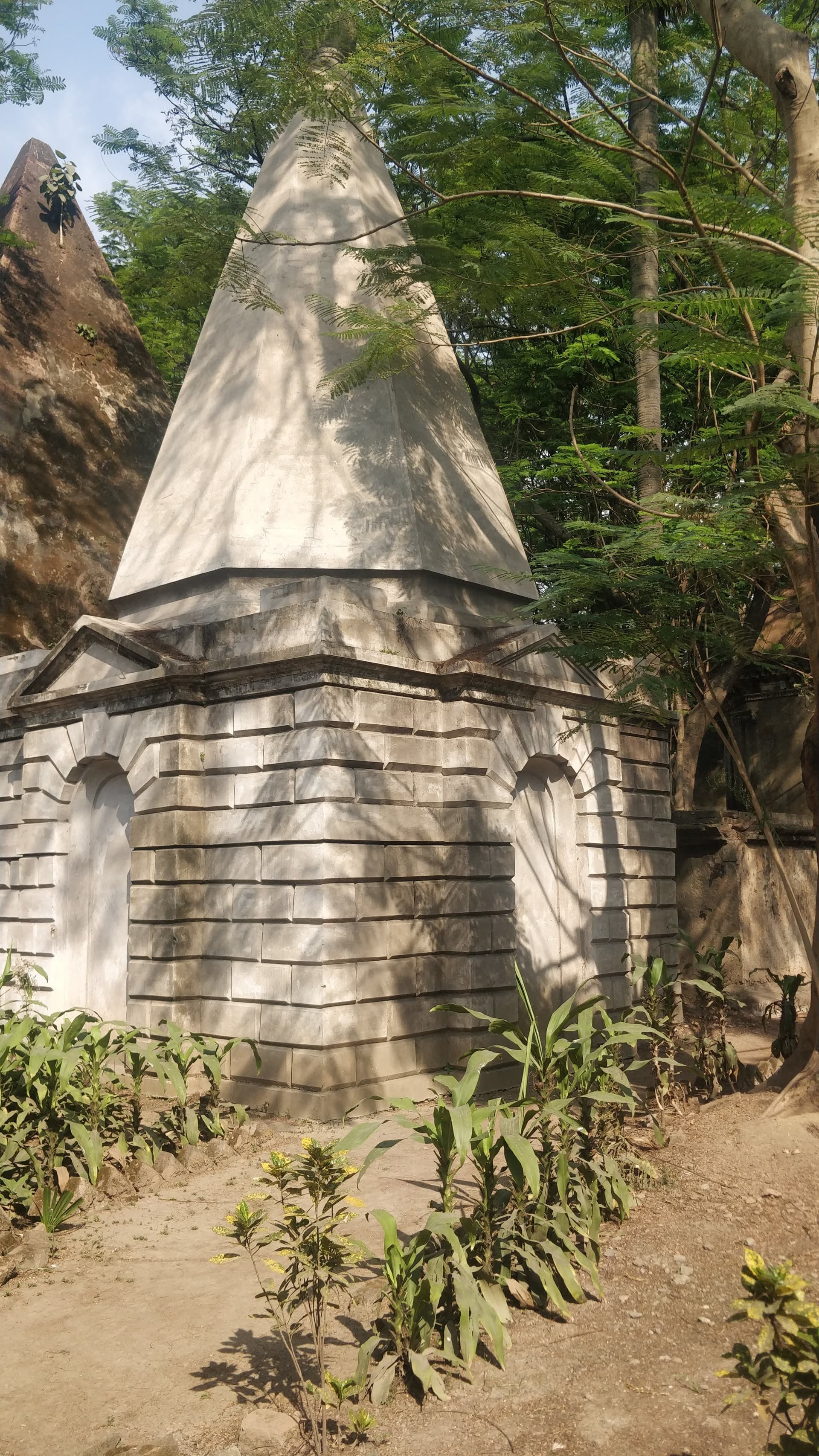
Conical, classical, rotunda — three very different answers to the same question
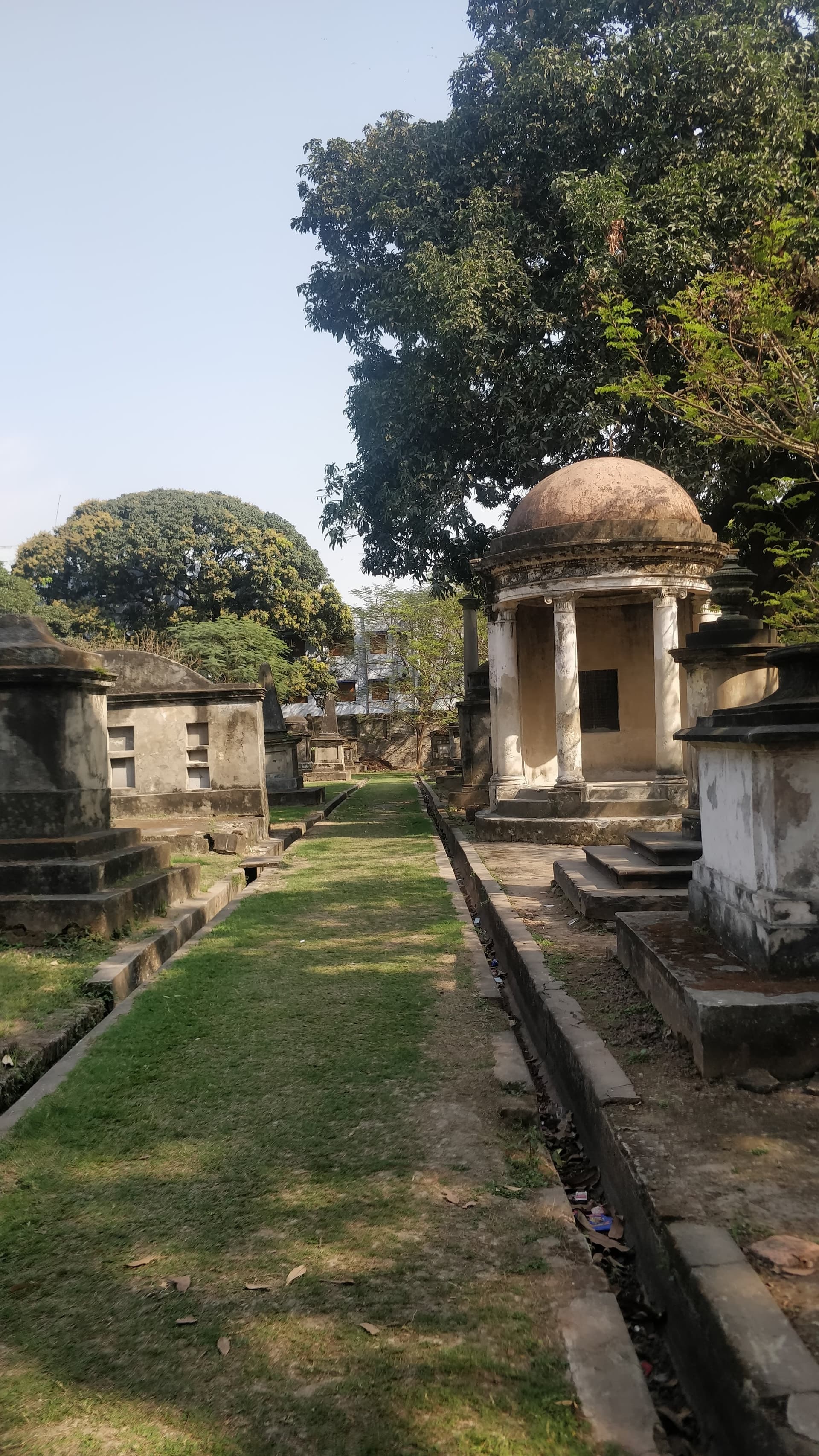
Conical, classical, rotunda — three very different answers to the same question

The Most Theatrical Tomb in Kolkata
And then there's this. A white pyramid with a skull-and-crossbones carved near the apex — Masonic symbolism, memento mori iconography, all of it pressed into stone under the South Asian sky. Someone wanted to be remembered dramatically. Of all the tombs in this cemetery, this one states its intentions most clearly.
The theatrical tomb stopped me both times — white pyramid, skull and crossbones near the apex, more memento mori than mourning. After that, the twisted obelisk and the round mausoleum feel almost restrained. The cemetery lets each family choose its own afterlife in stone.

The Twisted Obelisk
Nothing in the cemetery is quite like this spiralling form. It twists upward in a way that no other monument here attempts — as if the person buried below it wanted to be unsettled in death too. Its dark stone has absorbed decades of monsoon and heat and still it rises, unhurried and strange.

The round mausoleum — someone spent serious money on this. The tree growing beside the second is unimpressed.
Apple iPhone 13 — 5mm • ƒ/1.6 • 1/194 • ISO 40
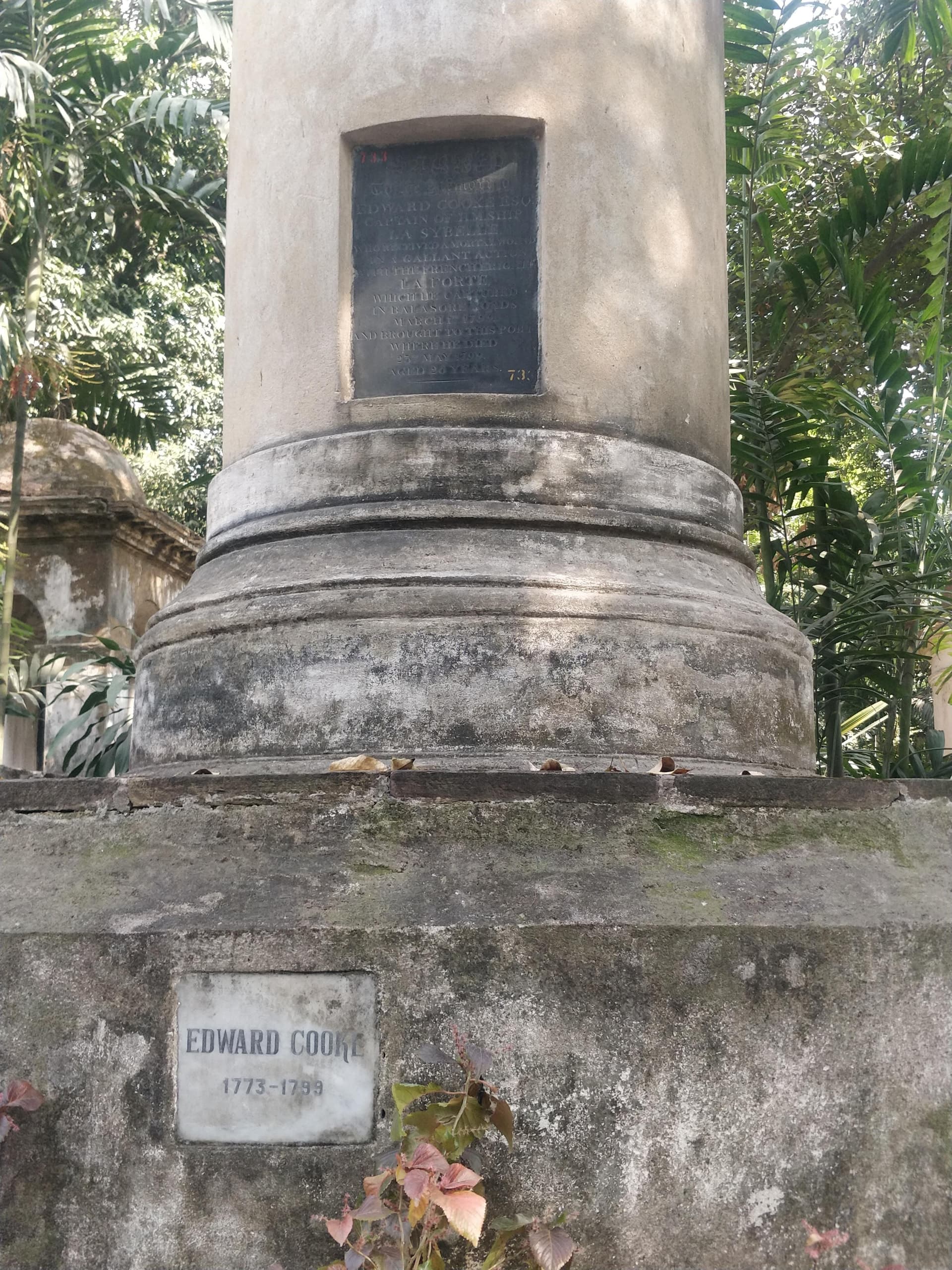
Edward Cooke, 1773–1799
He was twenty-six. The plaque on his column is weather-worn and partially illegible, but his name is still there at the base, cut into a small white tile as if someone wanted to make absolutely sure the stone didn't outlast the memory entirely. He came to Calcutta and didn't go back.

Henry Louis Vivian Derozio, 1809–1831 — poet, teacher, rebel, dead at twenty-two
Henry Louis Vivian Derozio is the exception in this cemetery full of British names. He was a Kolkata man — of Portuguese and Indian descent, a poet and teacher who lit up the Bengal Renaissance before dying of cholera at twenty-two. The fact that he is buried here, among the imperial dead, is itself a kind of statement. His bust is slightly apart from the others, and people still leave offerings.

Captain Charles Eggleston
"An honest man, a warm friend, a dutiful son and an affectionate brother." The words on Eggleston's stone are almost unbearably human. Not a soldier's epitaph. A family's. He died at Calcutta in September 1829, aged 57 — which, by the standards of this cemetery, was a long life. The stone is dark now, but the words are still clear enough to read.

Major George Downie — "honesty, purity of motive, and unconquerable courage"

"Beloved" — the last word still legible before the jungle finishes its work
The vines are patient. They don't hurry. They grow across the stones, over the names, between the carved roses. Given long enough, the jungle will write the final epitaph for everyone in here. In some corners of the cemetery, that process is already well advanced.

The older sections are barely navigable — the jungle doesn't care about history, it just grows

The older sections are barely navigable — the jungle doesn't care about history, it just grows
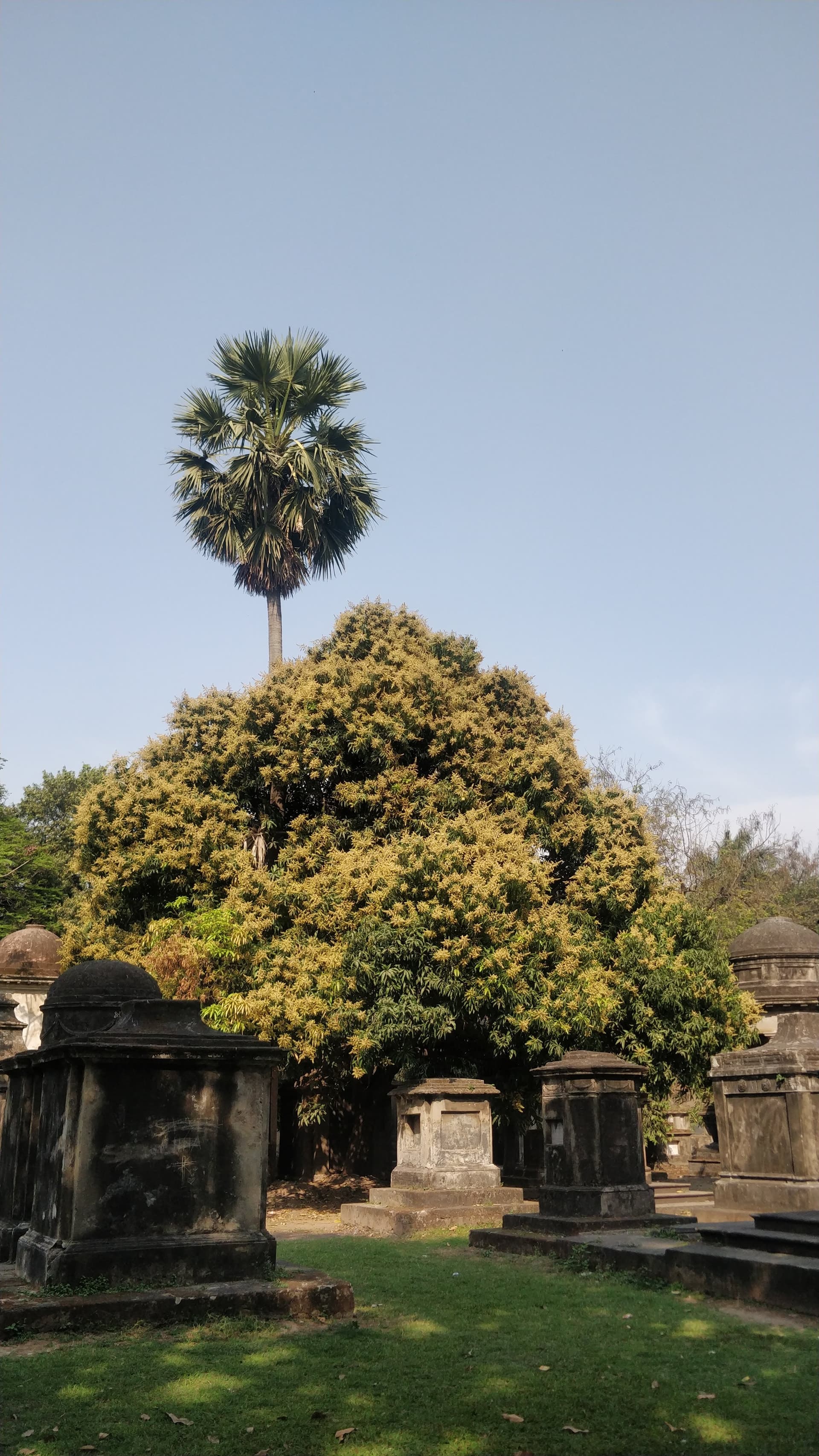
A palm tree rising above a mango in full bloom — tropical canopy over an English graveyard
"In one corner, a mausoleum has been almost entirely absorbed. You can see through the arch to the cemetery beyond — like looking through a portal. It is the most beautiful kind of ruin."
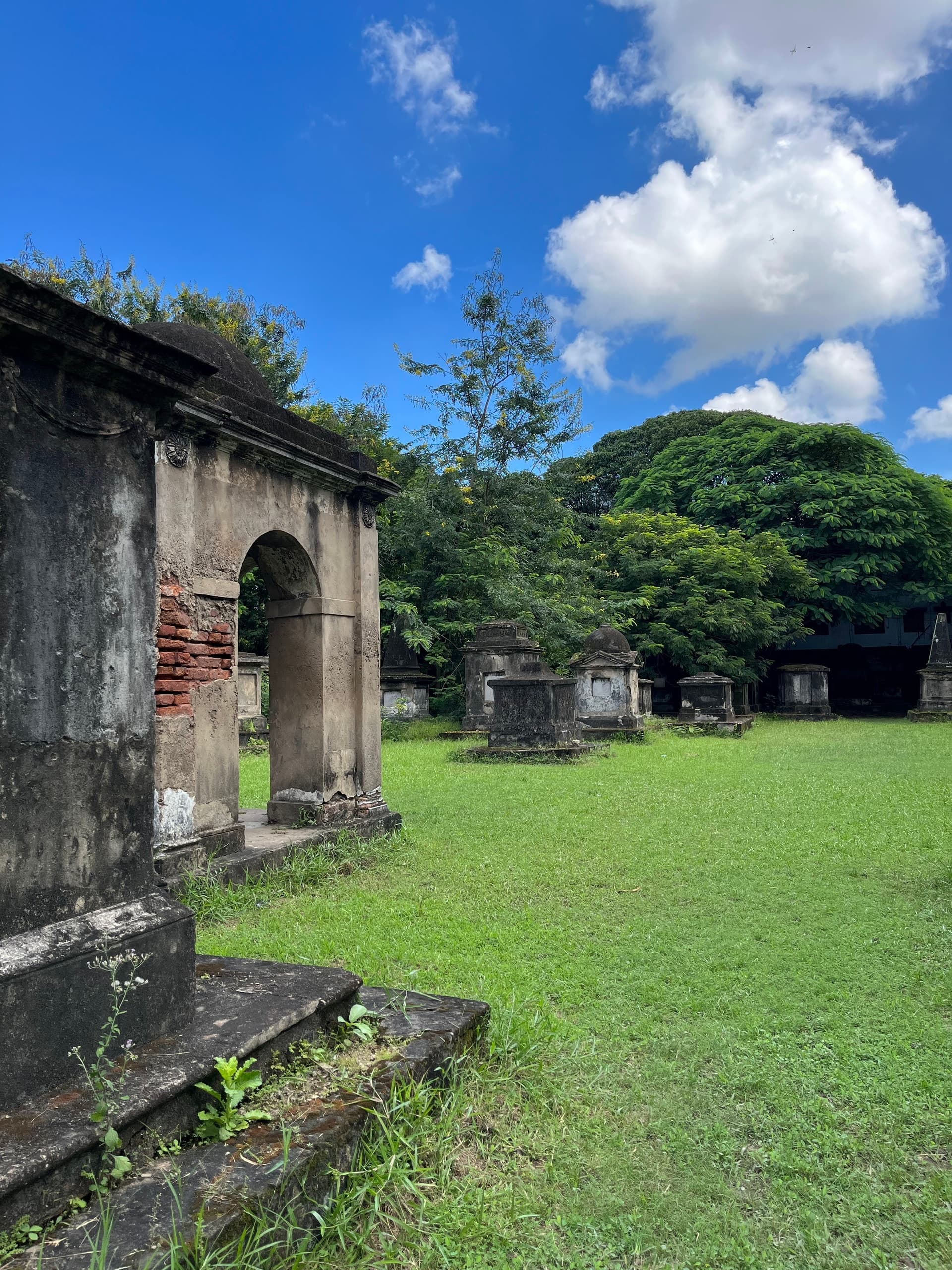
The green quarter — where the cemetery breathes
And then you come to a section where the trees open up, the sky is bright blue, and the tombs stand in a green field almost casually — like furniture in a room nobody uses. It is oddly peaceful. The birds are loud. The city is not.

The Bench Nobody Uses
Someone put a stone bench here, once. It's crumbling now, and nobody sits on it anymore. But it was an optimistic gesture — the idea that someone might come here not to mourn but just to sit and think, and that the cemetery might be the right place for that. I like that idea. I think it still is.

The river carried all of them here. And it keeps going, long after the stones stop being read.
You walk back out through the gate. Park Street is still Park Street — the cars and the hawkers and the afternoon crowd. The city has not paused. And then, a short cab ride away, the Hooghly. The river that carried all of them here, through Company routes and monsoon crossings and a thousand private hopes. The river that's still going, long after the stones stop being read. Kolkata is a city that keeps its dead close. Not as a morbid thing, but as a kind of honesty. Everything that was built here is still here — crumbling, overgrown, weathered into beauty. The cemetery is just the most literal version of that truth.
Quick reference
| Location | Park Street (Mother Teresa Sarani) — cemetery gate a short walk from the restaurant strip |
|---|---|
| Local ritual | Lunch nearby (e.g. Peter Cat) before the afternoon walk in — as most Kolkatans do |
| Entry fee | Free (small donations sometimes requested at the gate) |
| Hours | Roughly 9 am–5 pm; confirm locally on holidays |
| Time on site | 45–90 minutes if you want the older, overgrown sections |
| Getting there | Park Street metro · Taxi from Esplanade / Howrah ~15–25 min |
| Best time | Winter afternoons (Nov–Feb) for angled light; slides shot in February |
Common questions